
Why Thanksgiving Day Restaurant Hours Rarely Match Reality
The hours listed for a restaurant on Thanksgiving often have little to do with what you find at the door. You check the page, it says the place is open, you load the family into the car, and you arrive to a locked door and a dark dining room. That mismatch is common enough to be predictable. It is not bad luck, and it is not your mistake.
Most listings are not written by the restaurant itself. They are assembled from old business profiles, automated data feeds, and default holiday schedules that nobody revised, so a normal week of hours gets published as if it covered every day of the year, Thanksgiving included. On the holiday itself, staff are making last-minute calls about whether to open while the digital page still promises a table that does not exist.
What follows is how holiday hours actually get set, where listings fall behind, and the fastest ways to confirm before you drive. It also points you toward dependable restaurants open on Thanksgiving Day, so the meal ends with a full plate instead of a locked door. A few minutes of checking today can save a long, hungry drive tomorrow.
Why Your Search Says “Open” While the Door Says “Closed”
It is Thanksgiving morning. You search for restaurants open on Thanksgiving Day, and one result shows the green tag: “Open ⋅ Closes 9 PM.” You drive twenty minutes and find a dark dining room, a locked door, and a handwritten sign taped to the glass.
The restaurant may be blameless here. The problem is usually the listing.
Listed hours and actual operating hours are two separate records. What you see online is not a live view of the dining room; it is a stack of stored entries, each added at a different time by a different source, and they do not always agree with each other.
Layer One: The Default Weekly Hours
Nearly every listing begins with a default weekly template: open 11 a.m. to 9 p.m., Monday through Sunday, year-round. That template is the listing’s backbone, and it stays in place unless something explicitly overrides it.
Layer Two: The Holiday Exception
Holiday hours live in a separate field, treated like an add-on note. That field is often missing or stale. Nobody updated it, nobody verified it, and sometimes it has not been touched since the listing was first created years ago.
Why the Old Data Keeps Coming Back
Automated systems make it worse. Sync jobs run nightly, pull restaurant hours from whatever source is cheapest to grab, and republish them. A closure that was once recorded can be quietly overwritten by the default template on the next refresh. Aggregators also copy one another, so the same outdated schedule can reach dozens of sites within hours.
The Flag Nobody Toggles
Then there is the human side. Owners get buried in the holiday rush, and keeping a listing accurate means remembering to tick a single “closed on Thanksgiving” box. It is one checkbox, easy to miss while the kitchen is slammed. That untouched box becomes a false green light for thousands of hungry diners.
The listing looks confident and specific, but it describes a restaurant that is not there. The causes are consistent enough to list.
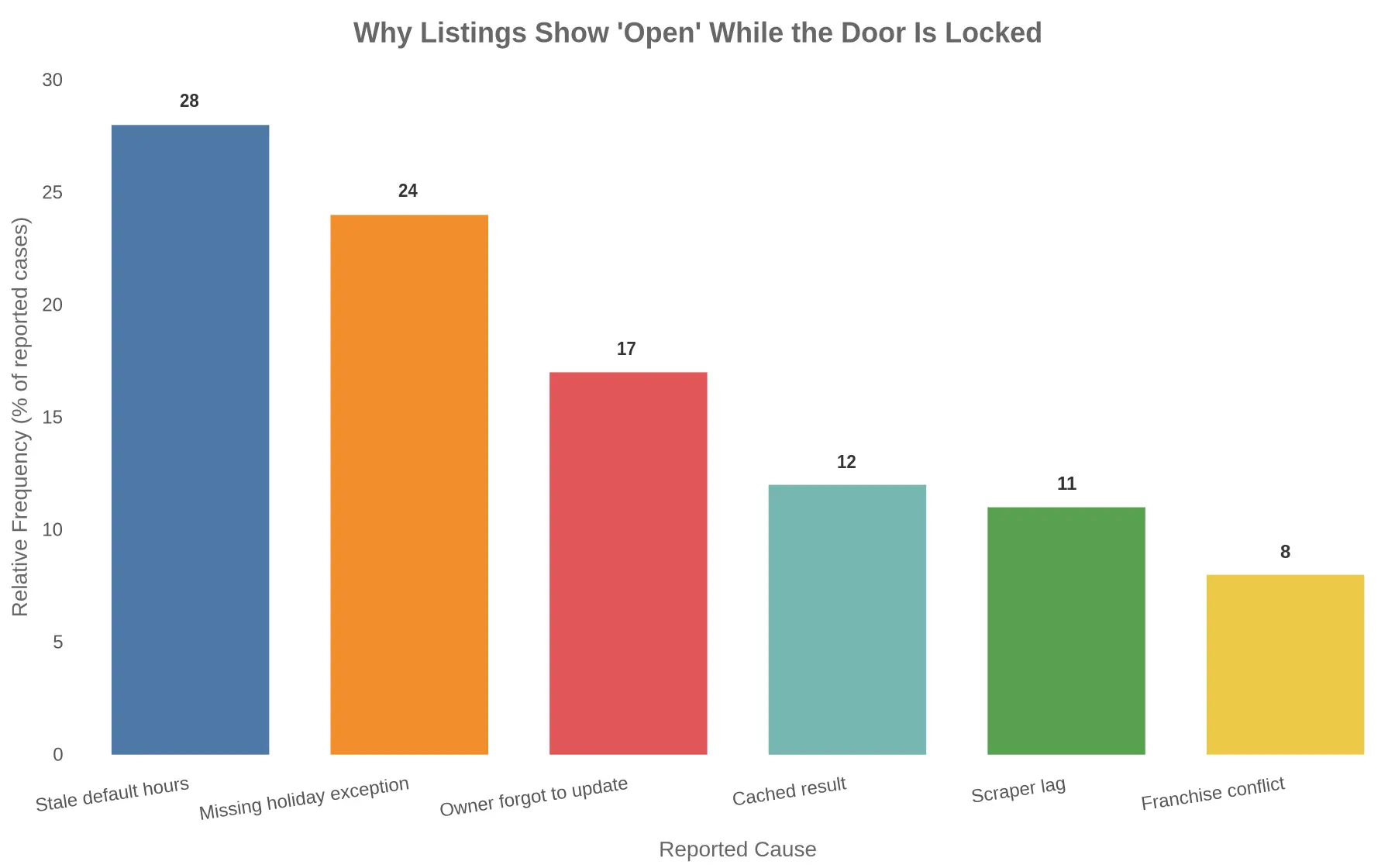
Top reasons a listing shows open while the door is locked
You searched, you found a spot with a green “Open” badge, you drove across town, and the doors were locked. When it comes to Thanksgiving Day restaurant hours, the gap between what a listing promises and what you find usually traces back to one of a handful of predictable glitches. Here are the most common, so you can spot them before you grab your keys, or check a restaurant’s official page first.
-
Stale default weekly hours – Many directory platforms pre-fill a restaurant’s profile with generic Monday-through-Sunday hours at sign-up, and those defaults never get replaced with the real schedule. The listing keeps showing “Open” because nobody ever corrected it.
-
Un-updated holiday exceptions – A restaurant may normally open at 11 a.m., but on a major holiday the team posts special hours or closes entirely with only a sign on the door. If that one-day exception never reaches the platform, the site keeps displaying the regular hours as if it were any other Thursday.
-
Third-party data scraping lag – Aggregator apps and mapping tools scrape hours from multiple sources and update them on a delay that can run from days to weeks. Even after a restaurant corrects its own page, the syndicated copy can linger with the wrong “Open” status until the next crawl.
-
Franchisee vs. corporate schedule conflicts – With chain locations, corporate offices sometimes push a single national holiday schedule to every profile, while individual franchisees decide locally to close. The corporate update wins on the listing, but the franchisee’s locked door wins in reality.
-
Owner forgot to update the platform – During a busy holiday week, a manager may update the phone greeting, the website banner, and the front-door sign, yet overlook the dozens of third-party listings nobody manages. Those profiles keep broadcasting the old hours.
-
Customers viewing a cached search result – Your browser, your search engine, or your phone’s saved map data often serves a stored snapshot rather than a live one. That cached “Open” label can be hours or even days out of date, so the page you are reading never reflected the actual closure.
Knowing these patterns will not unlock a door, but it can save you a wasted trip. When in doubt, confirm holiday hours by phone or on the restaurant’s own site before you head out.
How Listing Data Flows (and Where It Breaks)
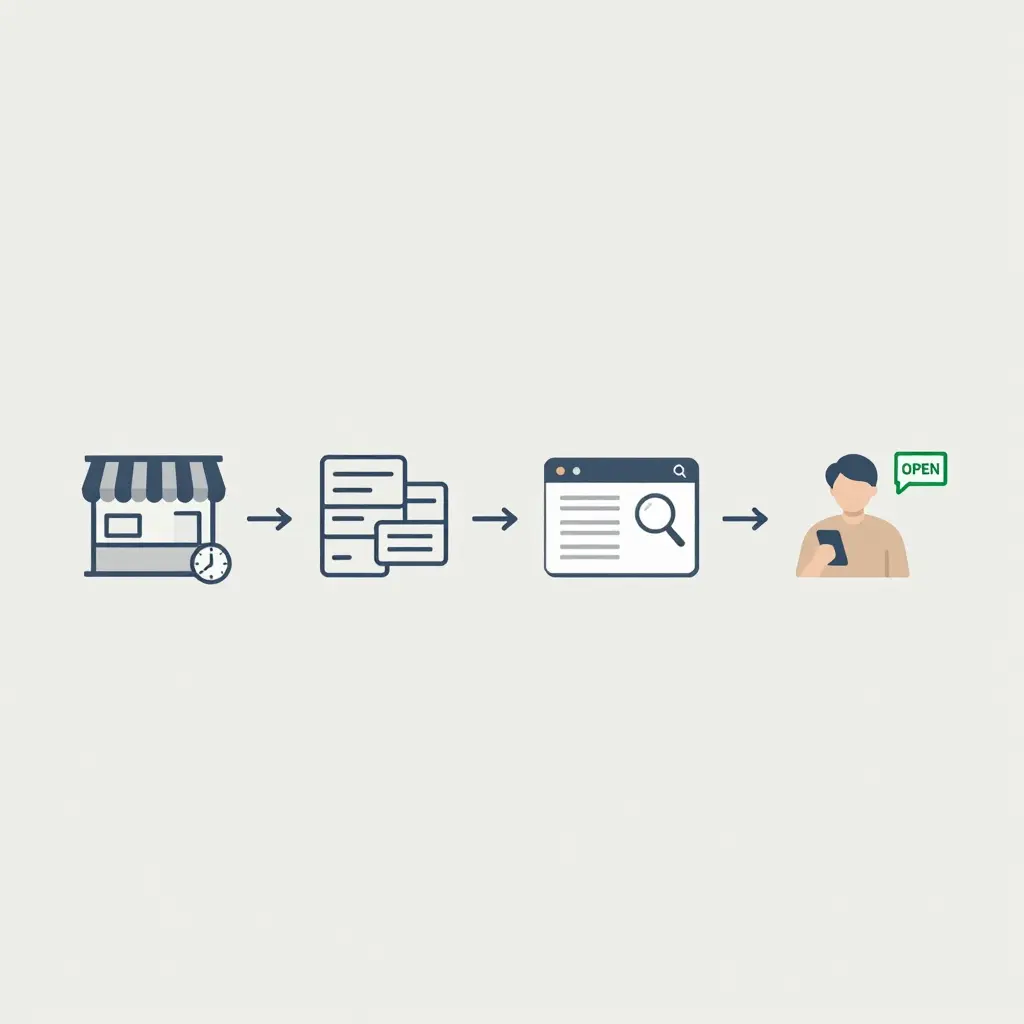
The pipeline looks simple: a restaurant updates its hours, the change travels to a data aggregator or directory, the aggregator pushes it to a search listing, and a diner sees open. Each arrow should be instant and reliable. In practice, every arrow is a place where information stalls, gets duplicated, or never arrives.
That is how a listing can confidently say a restaurant is serving Thanksgiving dinner while a locked door says otherwise. When you are comparing options for a traditional seafood Thanksgiving meal, a call ahead is the fastest way to confirm reality before you drive over.
How Third-Party Directory Data Updates
Most diners assume the hours in an online listing come straight from the restaurant’s own front desk. In reality, third-party directories, map apps, and review platforms assemble that information from a patchwork of sources: an aging business database, a periodic scrape of the restaurant’s website, or a single user-submitted correction. Each method carries its own lag, and the data changes only when someone decides to refresh it.
The reliability of any listing also hinges on whether it is owner-claimed or unclaimed. A claimed profile lets a restaurant push updates directly, flag a temporary closure, and answer questions in real time. An unclaimed listing leans on guesswork and crowd-sourced edits that often sit in a manual review queue before a moderator approves them, and those queues are worked by people, not algorithms. A genuine fix can stall for days.
Thanksgiving Day stresses every part of this system at once. A restaurant that publishes steady weekly hours may suddenly shift to limited holiday hours, close its doors entirely, or open for just a single seating. Platforms that scrape weekly schedules rarely catch a one-day exception, and unclaimed profiles can keep showing last year’s routine as if nothing changed. That gap is why diners searching for restaurants open on Thanksgiving Day so often meet a locked door behind a cheerful “Open” label. Comparing a platform’s version against a restaurant’s own posted schedule remains the safest habit of all.
How reliable are different listing sources for Thanksgiving Day hours?
Before you drive across town on Thanksgiving, remember that holiday hours are one of the most common reasons for a wasted trip. It pays to confirm the details on the restaurant’s own site and a trusted review page before you head out.
| Listing Source | Typical Update Speed | Who Controls the Data | Likelihood of Correct Holiday Hours |
|---|---|---|---|
| Restaurant’s own website | Slow to medium – only when staff remember | The restaurant itself | Highest, but still call to confirm |
| Map or aggregator app | Automatic, but often stale | Algorithms plus crowd edits | Low to medium |
| User-review platform | Very fast, often unverified | Reviewers and the community | Low – rarely holiday-specific |
| Reservation platform | Fast for bookable tables | Third-party booking company | Medium to high for seated dining |
| Social media page | Real-time, but easy to miss | Whoever runs the account | Medium if actively posted |
| Phone or directory listing | Rarely updated | Telecom and directory providers | Low |
No single source is fully trustworthy on its own, so treat the table as a starting point rather than a final answer.
How to Verify Thanksgiving Day Restaurant Hours Before You Drive
Before you build your holiday around a listing, treat those hours as a rumor, not a promise. Search results for restaurants open on Thanksgiving Day often pull from last year’s data, chain-wide defaults, or auto-generated profiles, none of which update when one location decides to close. That is how you end up staring at a page that says “Open” while a locked door stares back.
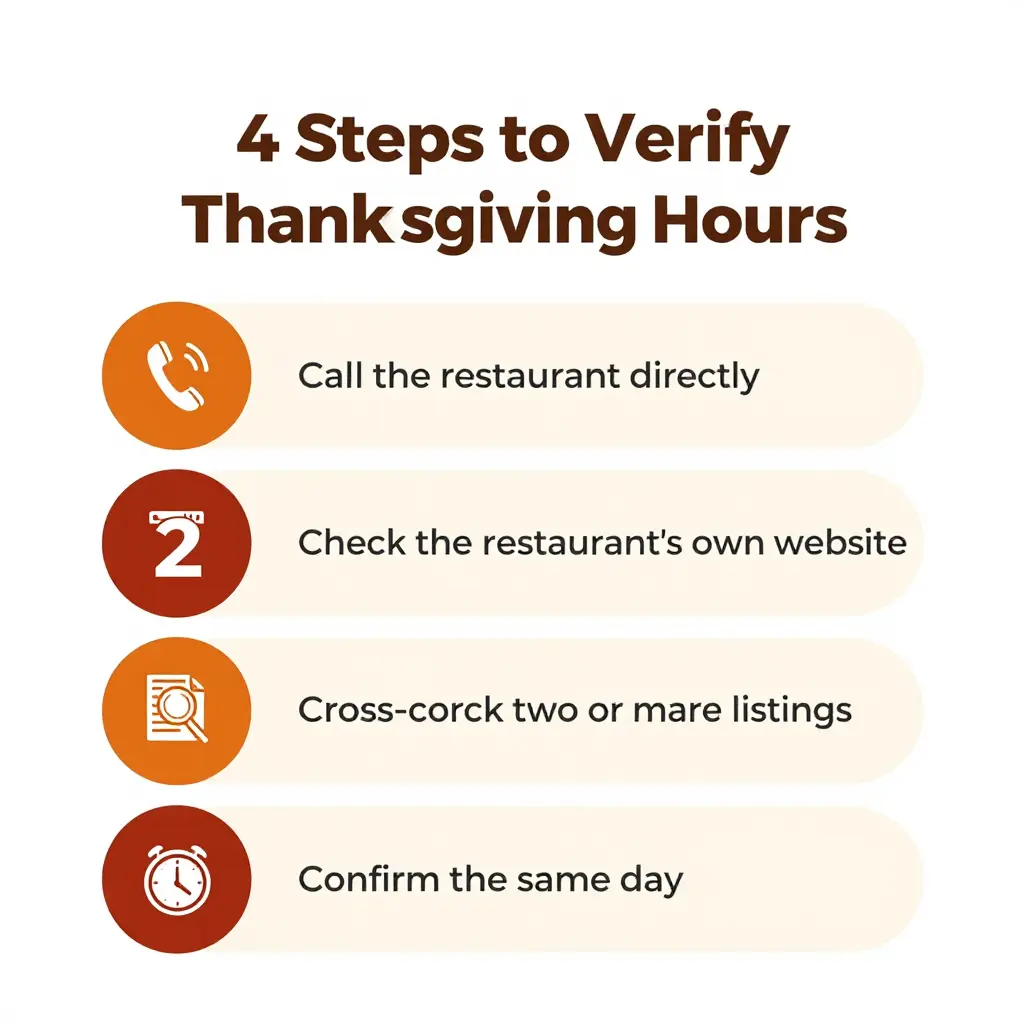
Verify in layers, and confirm close to the day. Start with the restaurant itself, not a third party. Then test that answer against a second source, and call again if the two do not match. Do it the same day you plan to eat, because a single morning decision can flip the sign.
Your 4-Step Verification Sequence
-
Call the restaurant directly. Dial the local number, not the corporate line. Ask two things: “Are you open on Thanksgiving Day?” and “What are your exact holiday hours?” A live person beats any web page.
-
Check the restaurant’s own website first. The official site and its holiday banner are usually the most current source. Look for a dated Thanksgiving notice, not a generic hours block.
-
Cross-check two or more listings. Compare Google, Yelp, and the restaurant’s social page. If two or more agree, your odds improve. If they disagree, trust the one you called.
-
Confirm the same day. A quick call or a glance at the restaurant’s social feed on Thanksgiving morning settles it. Hours can change fast, so confirm after you wake up, before you travel.
One phone call, one official page, one quick cross-check: that is all it takes to protect your Thanksgiving plan.
What the Bars Show
The bars rank the most common reasons a listing claims a restaurant is open while the dining room is dark, from stale default hours down to franchise-level conflicts. Small errors compound: a single missing exception can mislead a lot of hungry diners.
Holiday Hours Patterns: The Predictable Rhythms Behind a Locked Door
Thanksgiving is one of the few days when restaurant hours stop looking random. National chains tend to treat it as a special case: they post a dedicated Thanksgiving schedule, sometimes opening late, closing early, or running a trimmed-down menu, and many even advertise which locations count as restaurants open on Thanksgiving Day. Because those corporate decisions are documented on apps and websites, they are usually easy to verify before you drive over. Try checking the restaurant’s own page rather than trusting a stale directory snippet.
Independent restaurants usually take a simpler path and close for the entire holiday. Others unlock the doors only for partial windows: a short brunch service, a single seating, or a take-home meal built around pre-orders that must be reserved days in advance. This is where the gap appears. A listing may still show “open” because nobody updated the holiday hours, while the real door stays locked because the kitchen was never staffed for walk-ins. Third-party directories, and even some storefront pages, frequently pull from default data, so the “open” tag reflects a routine schedule rather than a decision made for that specific Thursday.
Chains broadcast their Thanksgiving plans widely; independents quietly close, shorten their day, or shift to pre-orders. That difference is what turns a simple “open” label into a mystery at the curb.
Where to Find Confirmed Open Restaurants
Before you bundle the family into the car, treat “open” as a claim that needs verifying, not a fact. The quickest way to confirm Thanksgiving Day restaurant hours is still a direct phone call during normal business hours. Ask specifically whether the kitchen is serving a holiday menu and when the doors actually close, since many places trim their schedule by several hours on the holiday itself. Then cross-check that answer against the restaurant’s own website or social feed, which usually posts a special holiday notice, rather than relying on a single set of aggregated online listings. If a listing shows hours but the phone simply rings out, assume the information is stale and line up a backup option.
Reliable confirmations tend to cluster in a few predictable places. Start with the restaurant’s official location page, where permanent hours and holiday announcements live side by side. Then use reservation platforms like OpenTable or Resy, which often disable booking for closed dates and reveal the truth instantly. Local news roundups and city food blogs also publish verified “open on Thanksgiving” lists each November. For a specific branch, you can check individual establishment pages, such as the Mayflower Seafood restaurant location details, to see posted hours and a contact number before you leave, so a locked door never catches you off guard.
Frequently Asked Questions About Thanksgiving Day Restaurant Hours
Why does a listing show a restaurant is open on Thanksgiving Day when it is closed?
Most listings pull hours from automated data feeds rather than from the restaurant itself. If a business never updates its holiday schedule, the platform keeps showing its regular hours, so the listing insists it is open while the door stays locked. The listing is not lying on purpose; it is running on outdated defaults.
Do national chains update Thanksgiving hours faster than local restaurants?
Generally, yes. Big chains have corporate teams that push holiday schedules to every platform at once, often weeks in advance. Local, family-owned spots usually update at the last minute, if at all, because no single person is assigned to manage their listings. That gap is why a chain’s online hours tend to be more trustworthy than a small diner’s.
How often are online listings updated?
Some platforms refresh their data daily, while others crawl on a fixed schedule that can run weeks or months between syncs. Even “verified” listings can lag, especially around a one-day event like Thanksgiving, when hours change and then snap back. This delay is the single biggest reason Thanksgiving Day restaurant hours go wrong.
Should I trust the restaurant’s own website over a third-party listing?
In most cases, yes. A restaurant’s own site or social media reflects what the operator actually decided, which makes it the most authoritative source for holiday hours. Third-party sites are useful for discovery, but treat their hours as a starting point rather than the final word.
What is the fastest way to confirm a restaurant is open on Thanksgiving Day?
Call the restaurant. It is still the fastest, most reliable check, especially on a holiday. If no one answers, look at the restaurant’s most recent social media post, which often announces closures within hours. You can also verify hours for specific locations to see whether a branch has posted a Thanksgiving update.
Why do some apps show yesterday’s hours?
Many apps cache (save) data so pages load quickly, and some only re-sync with source listings on a fixed schedule. If a restaurant changed its hours but the app has not refreshed, you end up seeing stale information from yesterday or earlier. That stale cache is why travelers hunting for restaurants open on Thanksgiving Day often get burned.
The Bottom Line: Listings and Reality Are Different Layers
It is tempting to treat an online listing as a promise, but what a search engine shows you and what is actually happening behind the restaurant’s door are two separate data records. Most of the time they agree, and on an ordinary day they are in sync. Thanksgiving Day is the weakest link in that chain. Holiday hours are the exception that breaks the pattern: staff head home early, a family-owned spot quietly flips off the lights, and an automated listing keeps cheerfully insisting it is open.
None of that is meant to make you nervous. It is meant to make you ready, and the fix is simple.
One Quick Rule Before You Head Out
Before you drive anywhere on Thanksgiving Day, call the restaurant directly and confirm its Thanksgiving Day restaurant hours with a real person. Look at the listing as a starting point, not the final word. If you are meeting family or traveling to a spot you have been meaning to try, make that call part of your routine, like checking the weather or grabbing your keys. Thirty seconds on the phone beats a cold, confusing drive to a dark dining room.
A listing can say open, but only a live voice can tell you the door is unlocked. When in doubt, call ahead before you go.
Quick Check: How to Verify Before You Travel
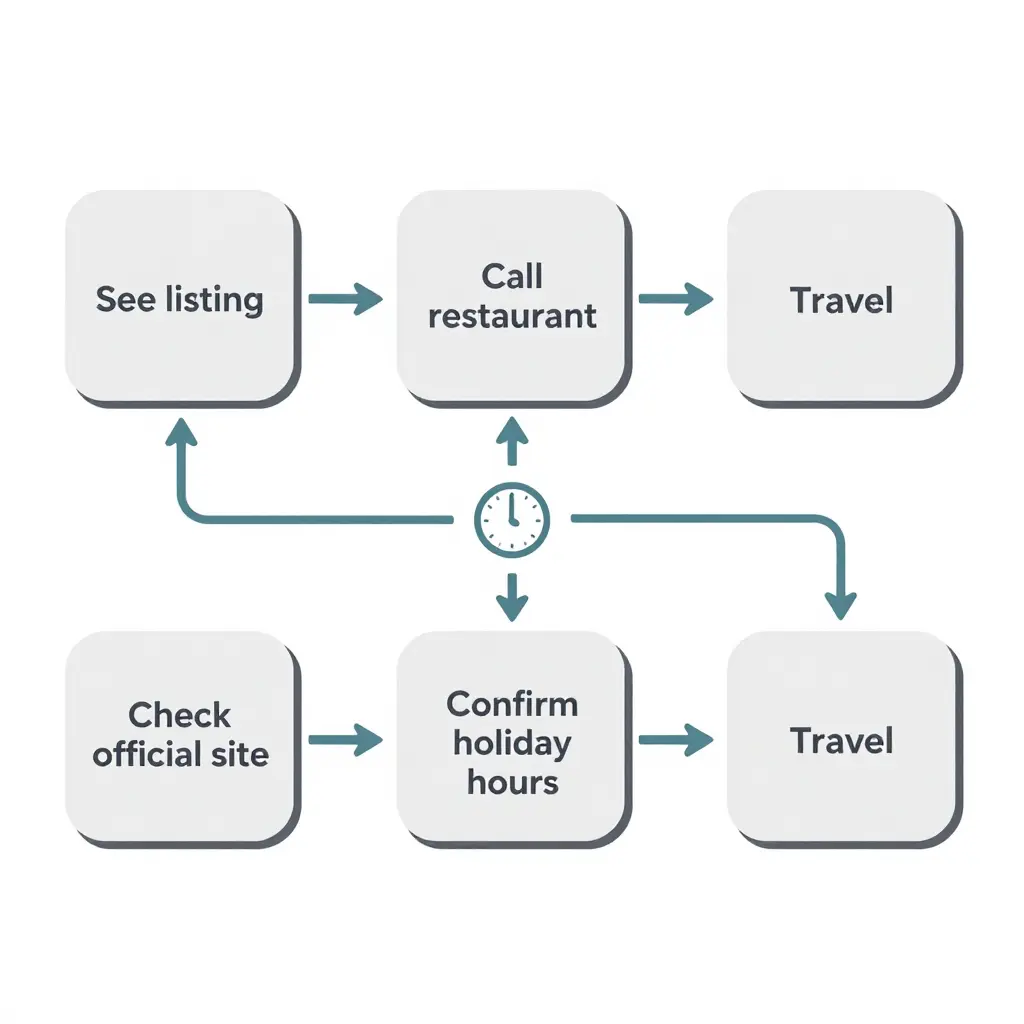
A listing that says “open” is a starting point, not a promise. Run this five-step flow before you load the car or call the family to the table. Each step costs you seconds and can save a wasted trip on Thanksgiving Day.
Why the Order Matters
Most people stop at step one and assume the listing is accurate. That is exactly where the confusion begins. Working left to right turns a guess into a confirmed plan:
- See listing – You spot a restaurant that appears open on a holiday.
- Call restaurant – A live human on the phone beats any automated update.
- Check official site – Compare the restaurant’s own hours against the aggregator.
- Confirm holiday hours – Ask specifically about Thanksgiving Day, not general hours.
- Travel – Only now do you drive over with confidence.
If you want to see how a restaurant that actually updates its own holiday schedule handles this, you can review Mayflower Seafood’s Winston-Salem location details before you head out.