
Why Thanksgiving Dinner to Go Has Become a Practical Plan
Ordering a cooked holiday meal stopped being a fallback a while ago. Hosts compare menus in early November now, reserve a slot, and drive home with dinner already in the bag. Whether takeout can work is settled. What still goes wrong is the specific order: collected at a certain hour, driven a certain distance, and asked to look and taste right when it reaches the table.
Three variables decide that: pickup timing, hold time, and dish type. Price, menu length, and packaging all count for something, but none of them will rescue a fried platter that spent ninety minutes in a warm car.
Pickup timing starts the clock
A pickup window is really the start of a countdown. Collect at 10 a.m. and the food has to survive the afternoon, often through a reheating cycle, before anyone sits down. Collect at 2 or 3 p.m. and the drive home is the only gap left. Work backwards from your serving time: subtract the drive, the unloading, and any oven time you’ll need. Mid-morning slots are the most requested and the slowest to clear, so take one only with a buffer.
Hold time is both a safety and a quality limit
Hot food has to stay above 140°F to be safe, and most dishes stop being good well before that line is in danger. Cold dishes run the other way: two hours out of refrigeration is the ceiling. Which means the packing plan comes before pickup, not after. Insulated bags for the hot pans, a cooler and ice packs for anything chilled, and a decision made in advance about what goes into the oven and what goes into the refrigerator.
Dish type decides what travels well
Roast turkey, mashed potatoes, stuffing, and braised greens are forgiving. They reheat cleanly, tolerate a slow drive, and hold heat in a sealed pan. Seafood has a narrower margin. Fried shrimp and oysters start losing crispness within 20 to 30 minutes in a closed container, crab cakes and scallops are best eaten soon after they come out of the kitchen, and shrimp cocktail or oysters on the half shell need a cold chain that stays away from the hot pans. If you are ordering seafood for the holiday, ask how each dish is packed, whether cold packs come with it, and how long the kitchen expects it to hold.
This guide covers pickup windows, hold times, and the seafood that survives a drive home. It does not cover full-service catering or eating on site.
Seven Decisions to Make Before You Order Thanksgiving Takeout
Most of the stress in a holiday takeout order happens before you reach the counter. A handful of choices made at ordering time decide how the food holds up in the car and how calm the last hour in your kitchen feels.
-
Choose a pickup window that fits your travel plan. Thanksgiving Eve and Thanksgiving morning slots fill first, and the earliest and latest ones usually go before anything else. Pick a window with room for traffic and parking, not one that assumes a perfect drive. Confirm the policy for late arrivals too, since a missed slot can push your order into a crowded holding area.
-
Size the order against your oven space. A big spread looks better on paper than it behaves at 4 p.m. Count racks, warming drawers, and slow cookers before you add sides. Ordering one or two fewer items often produces a smoother serving hour than a fully loaded table.
-
Separate hot-held items from cold-packed ones. Some dishes are meant to sit in a warmer until you collect them; salads, chilled seafood, and desserts travel better cold. Ask which category each item falls into so the coolers and hot bags get packed correctly, and which dishes need to be served first.
-
Pick seafood by your drive time. Fried and delicate items lose texture fastest; chilled shrimp, crab, and smoked fish tolerate a longer ride. Review the seafood menu before you order and match dishes to the length of the trip home. With more than thirty minutes on the road, weight the order toward cold-packed and reheat-friendly options.
-
Plan containers and carriers in advance. Sturdy boxes, flat-bottomed bags, and a cooler with ice packs if you are collecting chilled items. Loose bags tip, stack badly, and let heat escape on the way home.
-
Check your reheating capacity. Reheating takes oven space, time, and usually a splash of added moisture, so decide which dishes get reheated and in what order. Some items are best served straight from the bag; dense sides want a slower, lower warm-up. Write the sequence down so nothing sits out waiting for a turn.
-
Finish payment and confirmation early. Paying or confirming online shortens the counter conversation and cuts the chance of a mix-up on a busy morning. Save the confirmation number and the restaurant’s direct line somewhere you can find them. A call the day before also lets you adjust quantities while changes are still possible.
Once those are settled, pickup is a handoff rather than a scramble. Put your window, your packing plan, and your reheating order on one sheet.
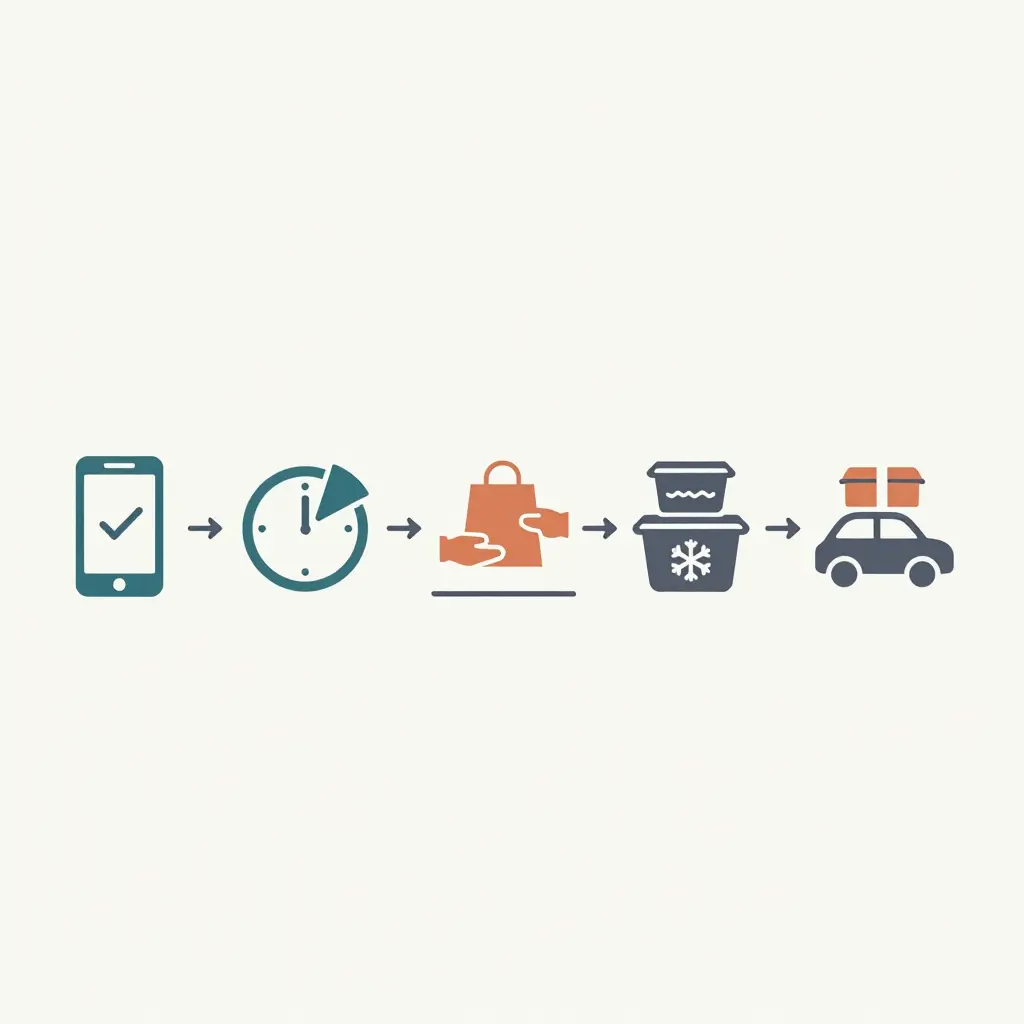
Figure: the five-step pickup sequence, from order confirmation to departure with your insulated carrier.
How Pickup Windows Work, and How to Choose One
A restaurant selling Thanksgiving dinner to go is not running a normal dinner service. On the holiday, hundreds of orders land inside a few hours, and the kitchen has to cook, portion, pack, and hand off every one of them. Open-ended pickup hours would turn that into a traffic jam with no end, so most kitchens batch orders into fixed pickup windows, usually 15 to 30 minutes long and spaced across the afternoon. Your window is a slot in a production schedule, not a suggestion.
Each window carries a set number of orders. That is how the kitchen knows how many turkeys and sides need to be ready at 1:00 p.m. and how many at 3:30. A later window means your food is packed closer to the moment you arrive, which is what protects its hold time.
Why Early and Late Both Cause Problems
Arriving early feels harmless. It usually isn’t. The counter is staffed for the window that is running now, the crew is still packing orders ahead of yours, and your order gets hunted for while the line backs up behind you.
Arriving late is worse for the food. Holiday meals are packed to hold for a limited stretch, and past that stretch gravy thickens, fried seafood goes soft, and chilled items warm up in a crowded pickup area. You end up serving something the kitchen didn’t intend, which is the real reason window accuracy matters.
How to Read a Pickup Window Confirmation
Most confirmations give you four things: the date, a window with a start and end time, the address with which entrance to use, and an order number or name for the counter. Read the whole window rather than the first time listed. “1:00 to 1:30 p.m.” means 1:00 is fine and 1:35 is not.
Look for notes about parking, curbside service, or a separate pickup line as well. If anything is unclear, it is worth confirming the details with the Winston-Salem location before the holiday week gets busy.
Build a Realistic Arrival Buffer
The common mistake is treating the window start as the moment to leave the house. Work backwards from three steps instead:
- Parking. Holiday lots fill quickly, so budget 5 to 15 minutes depending on the lot and whether curbside is offered.
- The counter queue. Even inside your window, expect a short line of guests collecting bags, checking orders, and adding last-minute items. Another 5 to 10 minutes.
- The drive home. Hold time starts at handoff, so a 20-minute drive is 20 minutes of holding.
Add those numbers to your serving time and you have a departure plan instead of a hopeful guess.
Match the Window to Your Serving Time
Decide when you actually want to eat, then subtract. A rough guide:
| Your serving time | Ideal window start | Buffer to plan for |
|---|---|---|
| 1:00 p.m. | 11:30 a.m. to 12:00 p.m. | 30 to 45 minutes |
| 3:00 p.m. | 1:30 p.m. to 2:00 p.m. | 45 minutes |
| 5:00 p.m. | 3:00 p.m. to 3:30 p.m. | 60 minutes |
If your family eats late and the last window is early afternoon, plan for reheating and ask which dishes survive it. Seafood is the hard case: a gentle reheat rescues a baked casserole and ruins anything fried.
So choose the window that puts the meal at home 30 to 60 minutes before you sit down, and arrive inside the slot rather than early. Treat the window as a commitment and both the counter line and the hold times stay manageable.
Pickup Windows at a Glance: Arrival Buffers and Hold Times
Pick a slot that fits your oven schedule, not just your errand list. The table pairs each common window with an arrival buffer and a hold time, so you can work backwards from the moment you want to sit down.
Please note: specific pickup windows and maximum hold times vary by location, by menu package, and by how busy the kitchen is that day. Always confirm both when you place your order.
Table: how much buffer to build in and how long each order can safely wait before serving.
| Pickup Window Type | Typical Order Load | Recommended Arrival Buffer | Maximum Recommended Hold Time Before Serving | Practical Note |
|---|---|---|---|---|
| Early-morning window (opening to ~10 a.m.) | Light; mostly single-family orders | Arrive 5-10 min early | Up to 4 hours (hold hot food above 140°F) | Quickest in and out; ideal if you plan to eat by early afternoon |
| Late-morning window (~10 a.m.-12 p.m.) | Moderate; families and early party orders | Arrive 10 min early | 3-4 hours | Traffic builds fast; park once and use curbside if offered |
| Early-afternoon window (~12-2 p.m.) | Heavy; peak holiday volume | Arrive 15 min early | 2-3 hours | Expect a line; keep a cooler in the car for chilled seafood |
| Mid-afternoon window (~2-4 p.m.) | Moderate to heavy; late planners | Arrive 10-15 min early | 2-3 hours | Good balance of shorter lines and same-day freshness |
| Last-window pickup, day before (final slot) | Very heavy; last-minute orders | Arrive 15-20 min early, expect a queue | Serve within 2 hours, or refrigerate promptly and reheat the next day | Closest to the holiday; ask for reheating instructions in person |
When you order, choose the window that still leaves the full buffer before your serving time, then ask staff to confirm hold times for your exact dishes. It is also worth checking the details for your nearest Mayflower Seafood location before you drive over.
Hold Times and the Food Safety Rules Behind Them
A to-go holiday meal runs on two clocks at once. One measures how long the food stays safe, the other how long it still tastes like the meal you pictured. Knowing when each clock starts, and when it runs out, is the difference between a relaxed Thanksgiving and a plate of dry salmon.
What “hold time” means for a prepared holiday meal
In a restaurant kitchen, hold time is how long a finished dish can sit at a set temperature before it has to be served or thrown out. For a to-go meal that window does not close when the lid goes on. It keeps running through the car ride, the greetings at the door, and the ten minutes you spend looking for the good platter. Your kitchen counter holds food to the same rules as a steam table.
Why hot food and cold food behave differently
Bacteria multiply fastest between 40°F and 140°F, the range food safety professionals call the danger zone. Above 140°F, heat keeps that growth in check, so the concern shifts from safety to quality: gravy thickens and skins over, fried shrimp lose their crunch, and scallops keep cooking in their own steam until they turn rubbery.
Below 40°F, growth slows to a crawl. Chilled dishes such as shrimp cocktail, crab salad, or oysters on the half shell stay safe far longer than they stay good. Refrigeration slows spoilage rather than stopping it: dressing dries out, citrus garnish wilts, and a seafood salad starts to weep within a few hours.
The two-hour rule for perishable food
Perishable food left at room temperature should be eaten or refrigerated within two hours, or within one hour if the room is above 90°F. The rule was written for buffet tables and applies just as well to a to-go bag on the passenger seat. It is a cumulative clock, not a reset button: moving a dish from the car to the counter does not restart it.
How the clock actually works for a takeout order
Three moments matter.
- Handoff time: the moment staff put the sealed bag in your hands. The clock starts here, not when you sit down to eat.
- Drive time: the minutes between handoff and your door. A stop for ice on the way home counts fully against your window.
- Serving time: when the food actually reaches the table, which is usually later than hosts plan for.
Pick up at 2:00 p.m. and serve at 3:30 and 90 minutes are gone before the first plate is passed, leaving roughly 30 minutes of margin on the two-hour rule.
Quality hold time versus safety hold time
Two different limits, and only one of them bends. Safety hold time is the outer boundary set by temperature and bacterial growth. Quality hold time is the shorter, softer number where a dish stops being at its best: fried items soften in 20 to 30 minutes, a hot bisque may hold an hour before it separates, and raw-bar items want to stay cold and undisturbed for the whole trip. Quality limits always arrive earlier, and safety is the one that decides whether the dish gets served at all. If something has been out too long, a good smell proves nothing, and reheating does not undo it.
Four hold-time rules worth taping to the fridge
- Start the clock at handoff. Ask staff to note the time the bag left the warmer. A written time lets you track the two-hour rule without estimating.
- Keep hot food hot and cold food cold on the road. An insulated tote for hot sides and a cooler bag with a couple of ice packs for chilled seafood keep both halves of the meal out of the danger zone.
- Serve within two hours of handoff, then chill the rest. Leftovers go into shallow containers inside that window, not after dessert.
- Ask before you order. Warmers, packaging, and recommended travel times differ from kitchen to kitchen, so it is worth asking a location directly about its holiday holding practices before you choose a pickup window.
None of this needs special equipment or a thermometer in the cupholder. It needs a start time and an honest estimate of the drive.
When you are ready to lock in a pickup window, call ahead with your questions about holiday holding practices at the Durham location and plan the order around your serving time rather than your departure time.
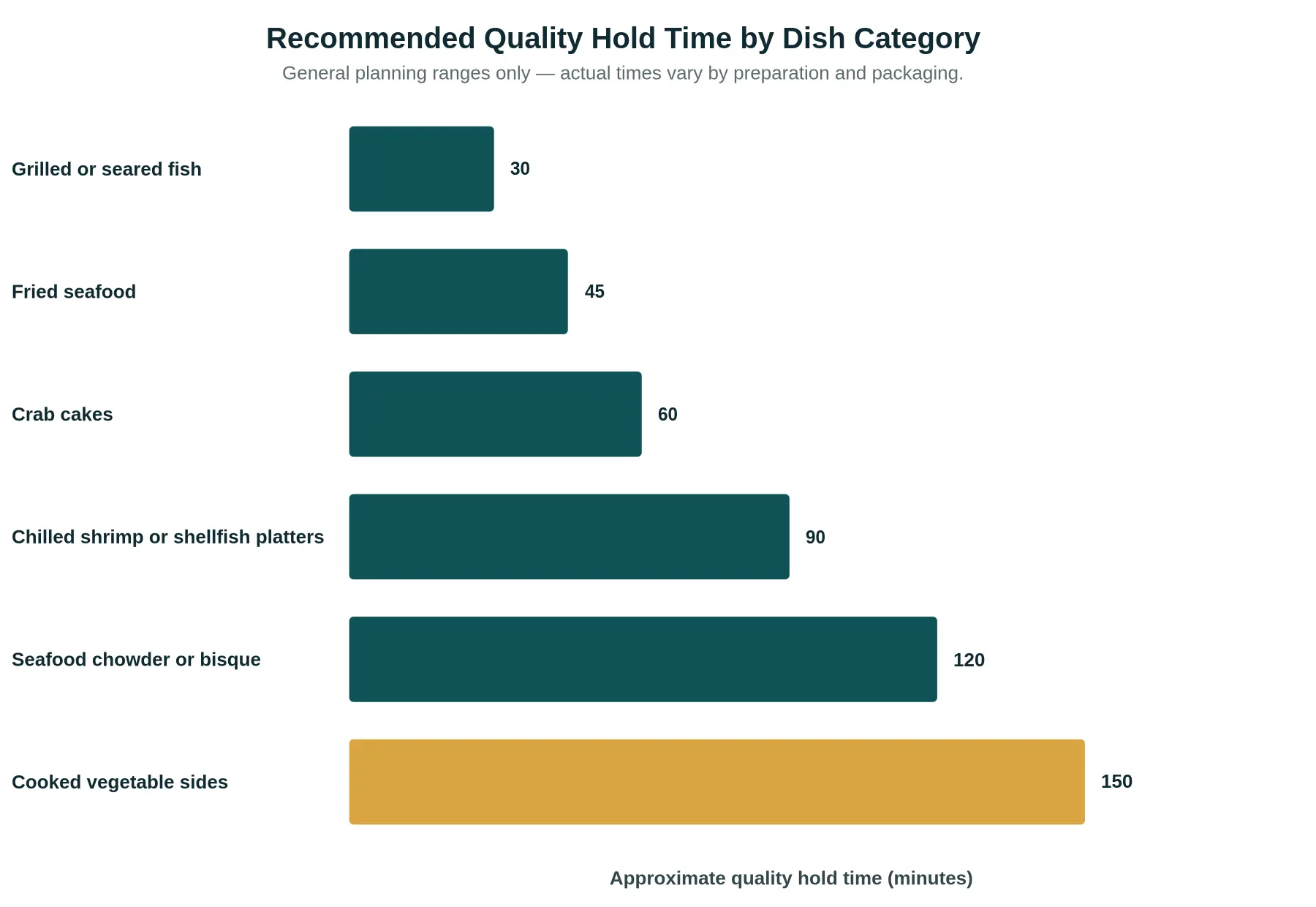
Compare your drive time against these bars. If the trip home runs longer than a dish’s range, pack it in a cooler or serve it first.
Which Seafood Dishes Survive the Drive Home
Some seafood handles a 30- to 60-minute ride in a warm car without complaint. Other dishes flatten out before you pull into the driveway. What follows is a dish-by-dish account of what travels, which packaging protects it, and the hold times you can plan around.
One thing worth confirming before you order: many coastal kitchens pack hot sides and cold shellfish in separate bags on purpose. Asking about regional seafood selections for holiday orders will tell you whether your pickup is organized that way, which matters more than any single dish on the menu.
Crab Cakes
Crab cakes travel well because they are dense and bound: the binder and crumb hold the meat in a compact patty that resists jostling. Serve them hot in a vented container so steam escapes and the crust does not go soft, or keep them chilled if you are plating them cold over greens. Figure on 45 to 60 minutes hot before quality slides, or about two hours at room temperature if served cold.
Chilled Shrimp and Shellfish Platters
Cold service is the safest bet on this list. There is no heat to lose and nothing overcooks in the container. A shrimp cocktail or mixed shellfish platter rides well in a cooler bag with a sealed ice pack, with cocktail sauce and lemon wedges packed separately so nothing turns watery. Two hours at room temperature is fine, and refrigerated it holds a full 24 hours, which makes it the easiest item to collect early in the day.
Smoked Fish
Smoking and curing pull moisture out and push salt in, so smoked fish is more forgiving than fresh. Vacuum-sealed fillets or a wrapped side of smoked salmon keep three to four days refrigerated, and two hours is still the room-temperature limit worth respecting. Ask for it sealed in a bag or lidded tray, and keep it away from hot sides that might steam the packaging.
Seafood Chowder or Bisque
Thick dairy-based soups hold heat remarkably well, because a full quart has real thermal mass and stays warm long after thinner soups have cooled. Order it in containers filled close to the rim, lidded, and wrapped in a towel inside an insulated tote. Ninety minutes is a reasonable window, and a gentle stovetop reheat restores it nicely, though you never want to boil a bisque or the cream will break.
Baked or Grilled Fish Fillets in Sauce
A sauce is insurance: it coats the fillet, slows moisture loss, and masks the slight overcooking that carryover heat causes in a closed container. The catch is delicate fish, which can go from perfect to flaky-mushy in 20 minutes, so request sauce on the side or choose a firmer species. Plan for 30 to 45 minutes, and reheat covered at low heat rather than in a hot oven.
Seafood Casseroles and Gratins
Casseroles and gratins are the sturdiest seafood dishes on a takeout menu: one pan, a uniform mass, heat that holds evenly from edge to center. The buttered crumb top will soften in transit, but the flavor and texture underneath come through fine, and a foil pan goes from bag to oven without a transfer. Sixty to 90 minutes hot is reasonable, and leftovers keep three days refrigerated.
Quick Reference: Realistic Hold Times
| Dish | Serving temp | Hold time | Best packaging |
|---|---|---|---|
| Crab cakes | Hot or chilled | 45-60 min hot / 2 hrs room temp | Vented rigid container |
| Chilled shellfish platter | Cold | 2 hrs room temp / 24 hrs refrigerated | Cooler bag with ice pack |
| Smoked fish | Room temp or cold | 2 hrs room temp / 3-4 days refrigerated | Vacuum seal or lidded tray |
| Chowder or bisque | Hot | 90 min | Filled-to-rim quart, wrapped |
| Baked or grilled fillets | Hot | 30-45 min | Sauce on side, shallow tray |
| Casserole or gratin | Hot | 60-90 min / 3 days refrigerated | Original foil pan, lidded |
What Travels Well, and the Two Rules Behind It
The dishes that travel best share three traits: they are served cold or thick-sauced, they have enough structure to survive a bumpy ride, and they do not depend on a crisp edge to be good. Judge any takeout item on those three points plus your actual drive time, then hold two temperature lines in transit: hot food above 140°F, cold food below 40°F.
How long will your seafood hold up on the drive home?
The distance between the pickup window and your table is the one variable you control, so treat it as a menu filter. Work out your realistic door-to-door number, then read only the dishes that survive it. Anything rated shorter than your drive is a gamble, no matter how good it looks on the seafood lineup Mayflower is known for.
| Dish | Why It Travels Well or Poorly | Best Packaging | Quality Hold Time | Reheat or Serve Cold | Best For (Drive Time) |
|---|---|---|---|---|---|
| Crab cakes | Dense and well bound, so they hold their shape | Rigid vented container, parchment between layers | 45-60 min | Reheat in oven or air fryer | 20-40 min drive |
| Chilled shrimp platter | Already served cold, but ice melts and greens wilt | Sealed tray on gel packs, cocktail sauce separate | 2 hrs | Serve cold | 45 min+ drives |
| Oysters on the half shell | Raw and fragile, shell liquor spills and tips | Lay flat on crushed ice, snug lid, no stacking | 30-45 min | Serve cold | Under 20 min drive |
| Fried shrimp | A closed box traps steam and softens the crust | Paper-lined box, lid cracked, vented bag | 20-30 min | Reheat hot and fast | 15-25 min drive |
| Fried fish | Thin coating goes limp and the aroma travels | Rigid box with a paper vent, kept upright | 20-30 min | Reheat in skillet or air fryer | 15-25 min drive |
| Smoked fish | Cured and low in moisture, shrugs off a warm car | Vacuum seal or butcher paper in a cool bag | 2 hrs room temp | Serve cold or room temperature | Any drive length |
| Chowder or bisque | Thick soup holds heat but sloshes and leaks | Screw-top quart filled to the brim, towel-wrapped | about 90 min | Reheat gently, stir often | 30-60 min drive |
| Baked fish with sauce | Fillets flake apart and sauce soaks the flesh | Shallow pan, lid ajar, sauce packed separately | 30-45 min | Reheat covered on low | 20-30 min drive |
| Seafood casserole | A heavy insulated mass that stays hot to the center | Foil-covered baking dish inside a cooler bag | 60-90 min | Reheat covered at 325°F | 30-60 min drive |
| Crudo, sashimi or ceviche | Raw or citrus-cured, no heat buffer, texture collapses | Sealed container on gel packs, ice above and below | 30 min max | Serve cold on arrival | Under 15 min drive |
Table: how well each holiday seafood dish survives the ride home, matched to packaging, hold time and serving method.
One habit worth keeping: pack cold dishes and hot dishes in separate bags, then load the cold bag last and unload it first. Two minutes of work that buys back most of the quality a long drive takes away.
Seafood Dishes That Lose Quality in Transit: What to Know Before You Drive Home
Nothing about a good seafood plate is fragile in a fussy way. It is fragile predictably: heat escapes, steam collects, emulsions cool, and a crust that was crisp three minutes ago starts pulling moisture out of the fish beneath it. That is not a reason to skip ordering. It is a reason to plan the pickup around the dish instead of the other way around. Five kinds of seafood decline fastest on the ride home; below is what happens inside the container and the adjustment that keeps each one close to restaurant quality. On Thanksgiving, when the car is also carrying four sides and a pie, those adjustments matter more than usual.
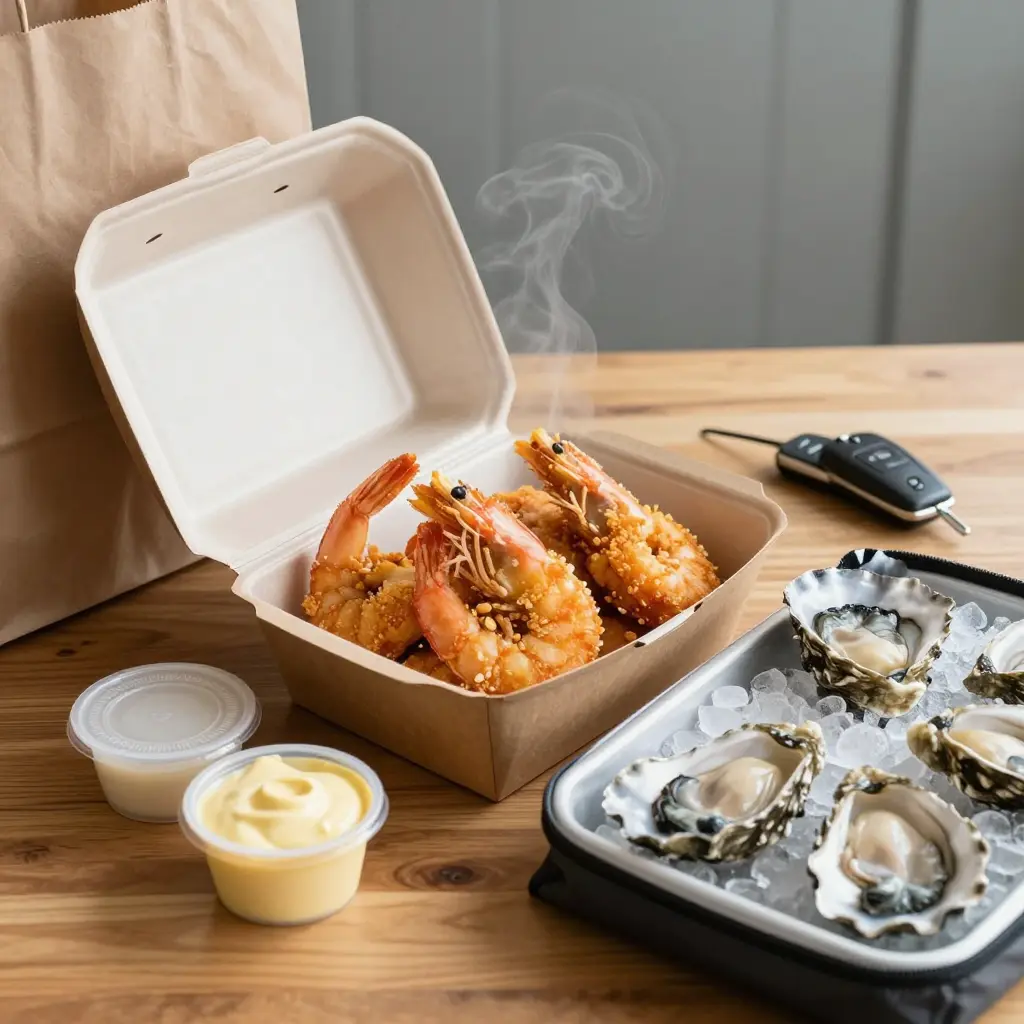
Fried Shrimp, Oysters, and Fish: The Steam Trap
A fried crust is a dry, porous shell, and the fish inside is still releasing moisture as it cools. In a sealed clamshell that vapor has nowhere to go, so it condenses on the lid and rains back onto the breading, which absorbs it and softens from the outside in. Most fried seafood is noticeably less crisp after 15 minutes and genuinely soggy after 30.
Ask for vented lids, or a paper-lined box with the corners cracked, and keep any sauce or dip in its own cup rather than poured over the top. Venting and lining styles vary from kitchen to kitchen, so it is worth asking about packaging for fried items when you order. If your drive runs longer than 20 minutes, order the fried platter only when you plan to eat within the first half hour of arriving.
Raw Shellfish and Crudo-Style Preparations
Oysters on the half shell, chilled shrimp, and crudo all depend on holding a cold temperature, and a warm car undoes that faster than most people expect. Crudo and ceviche also keep “cooking” in their citrus dressing: a delicate slice of snapper that was silky at the counter turns chalky and opaque by mile ten.
Treat these as the first thing you load and the first thing you serve. A small insulated bag with a freezer pack keeps them cold for a typical 20-to-30-minute ride. Better still, order raw and crudo-style plates only for a short drive, or choose a cooked alternative on longer trips and save the oysters for a night you are eating close to home.
Delicate Whole Fish and Skin-On Fillets
The skin is the first casualty. It crisps at the restaurant, softens against the trapped humidity in a closed box, and the flesh underneath keeps cooking from residual heat, drying slightly at the edges. Put that fillet in a container where it can slide and stack against itself, and a whole fish arrives looking closer to a fish cake.
Request a flat, shallow container so the fish lies in a single layer with nothing resting on top, and ask for sauce on the side so it does not pool underneath and poach the skin further. Serve it the moment you arrive. If you must wait, a few minutes in a hot oven on a sheet pan will bring the skin back partway.
Anything With a Crisp Topping or Crust
Crab-stuffed flounder, parmesan-crusted cod, breadcrumb toppings, fried onion garnish: two ingredients with opposite needs in the same box. The topping wants dry heat. The seafood beneath it releases steam continuously, and the crisp layer absorbs that moisture until it turns into a damp blanket.
Ask for the topping or crust packed separately and add it at home, then run the dish under a broiler or in a 400°F oven for five to eight minutes to re-crisp the surface. If the kitchen cannot separate them, save this one for a drive under 15 minutes.
Thin Butter and Wine Sauces That Break
A pan sauce built on butter, wine, and stock is a fragile emulsion: fat droplets suspended in liquid by heat and agitation. Once it cools in a takeout cup, the butterfat congeals and separates, and reheating too fast finishes the job, leaving a slick of oil over thin liquid.
Have these sauces packed in a separate container and reheat them gently over low heat, whisking steadily, or in short microwave bursts with a stir in between. If your route is long, or the food will sit through a slow holiday table, choose a cream-based, tomato-based, or thicker sauce that holds its texture more gracefully.
Quick Reference: Hold Times and Better Moves
| Dish style | Realistic hold time after pickup | Best workaround |
|---|---|---|
| Fried shrimp, oysters, or fish | 20-30 minutes | Vented lid, sauce on the side |
| Raw shellfish and crudo | 20-30 minutes on ice | Insulated bag with ice packs, serve first |
| Whole fish or skin-on fillets | 20-25 minutes | Flat single-layer container, no stacking |
| Crisp-topped or crusted dishes | 25-30 minutes | Topping packed separately, re-crisp at home |
| Thin butter or wine sauces | 30-40 minutes | Sauce in its own cup, reheated gently and whisked |
Those numbers are guides, not guarantees, and they assume a closed car on a mild day. A hot August afternoon or a long detour pushes every one of them down.
The Rule of Thumb
Match the dish to the drive. Under 15 minutes, order anything on the menu, fried plates and raw oysters included. Beyond 30 minutes, build the meal around braises, chowders, crab cakes, and cream- or tomato-based sauces that improve with a little rest. Everything else comes down to asking for the right container and serving the food the moment you walk through the door.
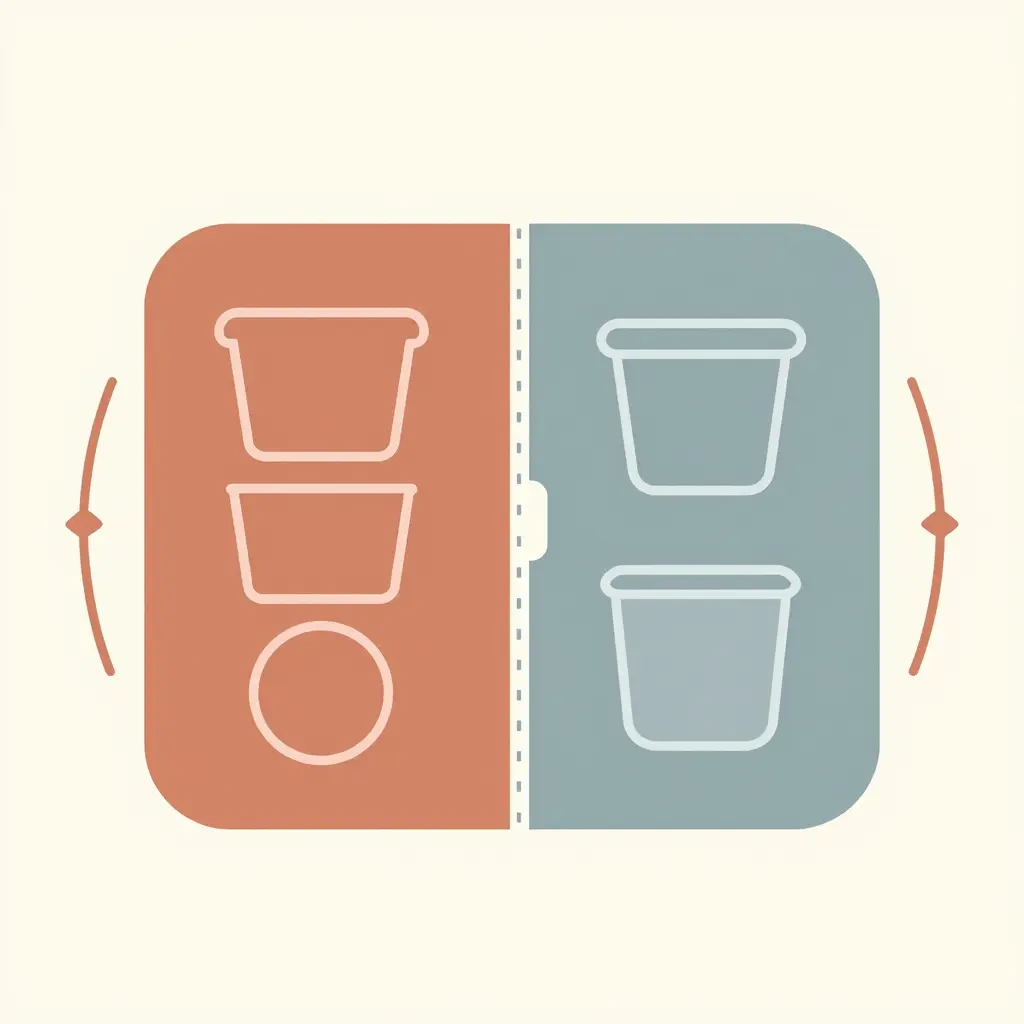
Keep the heat and the chill from trading places: hot containers on one side, cold seafood and the gel pack on the other, with a slim buffer of empty space down the middle.
Reheating, Plating, and Serving Your Thanksgiving Dinner to Go
You made it home with the boxes still warm and the car smelling like butter and thyme. Now comes the part nobody plans for: turning a stack of containers into a table that looks like someone cooked all day. A good pickup ends at the table, not at the counter, and most of what stands between the two is sequencing.
Start with triage at the door. Open every box, sort what is hot from what should stay cold, and send the cold items straight to the refrigerator before they sit through the unpacking. Group what is left into three piles: oven, stovetop, and counter-rest. Most hot items stay safe for about two hours out of temperature control, but quality fades much faster than safety does, so the clock you are racing is really about texture.
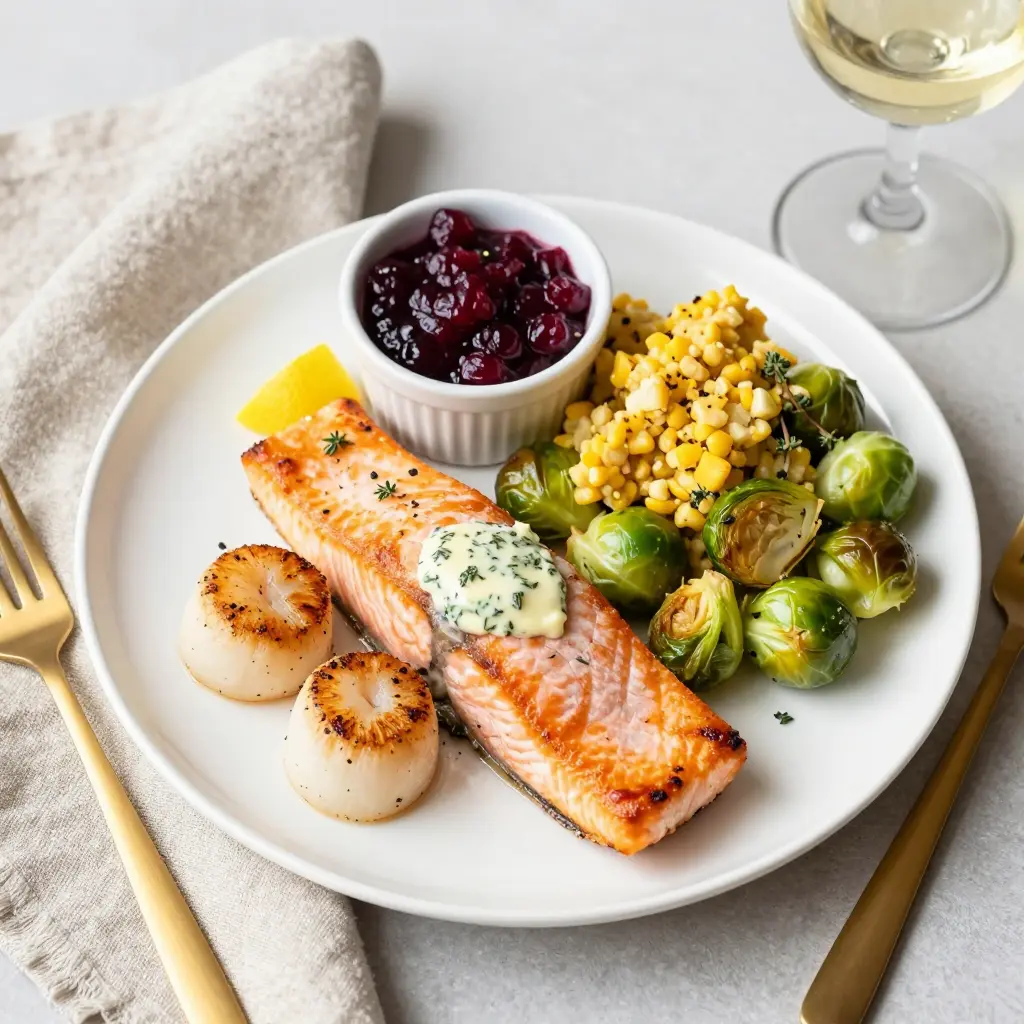
Reheating Steps, in Order
- Read the reheat card before you touch the oven. If your restaurant provided reheating guidance, follow it. Those instructions are written for their exact recipes and portion sizes, and a restaurant’s own reheating guidance usually beats a general rule.
- Chill the cold items immediately. Cocktail shrimp, oyster platters, smoked fish, and dressed salads go into the refrigerator first, uncovered for ten minutes to release trapped steam, then covered.
- Preheat the oven to 350°F (175°C) and load the dense items first. Stuffing, potato gratin, casseroles, and root vegetables need 20 to 25 minutes; give them the head start.
- Add the delicate seafood in the final 10 to 15 minutes. Cover it loosely with foil so it warms through without drying at the edges.
- Move sauces, soups, and gravies to the stovetop. Warm them over low heat, stirring often, and never let them boil. A rolling boil breaks butter sauces and turns chowder grainy.
- Rest everything for five minutes, then plate. The rest evens out internal temperature, and sauce goes on without a puddle forming.
Hot Seafood: Temperatures and Methods
Reheated food should reach 165°F (74°C) internally, checked with an instant-read thermometer in the thickest part. Seafood gets there fast, though. Shrimp and scallops need only 8 to 10 minutes at 350°F, a salmon fillet about 10 to 12, and crab cakes do best with dry heat, 400°F for 6 to 8 minutes on a sheet pan, so the crust comes back instead of steaming into mush. Skip the microwave for fish; uneven heat is what turns a fillet rubbery in ninety seconds. If you have to use it, go 50% power in short bursts and let carryover heat finish the job.
Serve These Cold – Never Reheat
Some things are built to stay chilled, and warming them ruins them:
- Shrimp cocktail, oyster platters on ice, and chilled crab or lobster salad
- Smoked salmon, ceviche-style starters, and any dressed greens or slaw
- Dairy-heavy items like cucumber salad or a cream-based dessert
Keep these in the refrigerator until the last possible minute, then bring them out as the opening act.
Bringing Texture Back
Containers trap steam on the drive home, so expect a few softened edges. Vent the lids for the first few minutes at home to let that moisture escape. For anything that should be crisp, such as fried oysters, crusted fish, or roasted potatoes, finish it at 425°F (220°C) for 3 to 5 minutes on a bare sheet pan, no foil. Stuffing benefits from a splash of stock and an uncovered bake. Reheat sauces separately and spoon them over at the table.
Plating Like You Meant It
Warm your plates in a low oven for a few minutes. Wipe the rims. Put sauce under or beside the protein rather than over it, so the crust stays intact. Add one fresh element, whether that is lemon wedges, chopped parsley, or a scatter of flaky salt.
A serving order that keeps the table moving:
- Cold seafood first. The shrimp cocktail and oyster platter go out immediately, buying you time while the oven finishes.
- Hot seafood and starches next. Plate the fish and shellfish alongside the stuffing and potatoes while they are at their best.
- Sides, sauces, and bread last. Gravies, butter sauces, and rolls round out the table once everyone is seated.
Chill what should be cold, read any reheating card, then load the oven from densest to most delicate and give crisp items a brief blast of high heat. Rest, warm the plates, garnish simply, and serve the cold seafood first while the hot dishes settle.
How Long Will Your Hot Seafood Actually Stay Hot?
Once the car door closes, the clock is running. The chart below is the mental model behind every pickup-window decision: heat leaks out of a hot seafood dish fast, and the container decides whether you get a leisurely drive home or a nervous one. The dashed line is an open or vented container sliding toward the 140°F hot-holding threshold. The solid line is a closed insulated carrier buying you a real buffer.
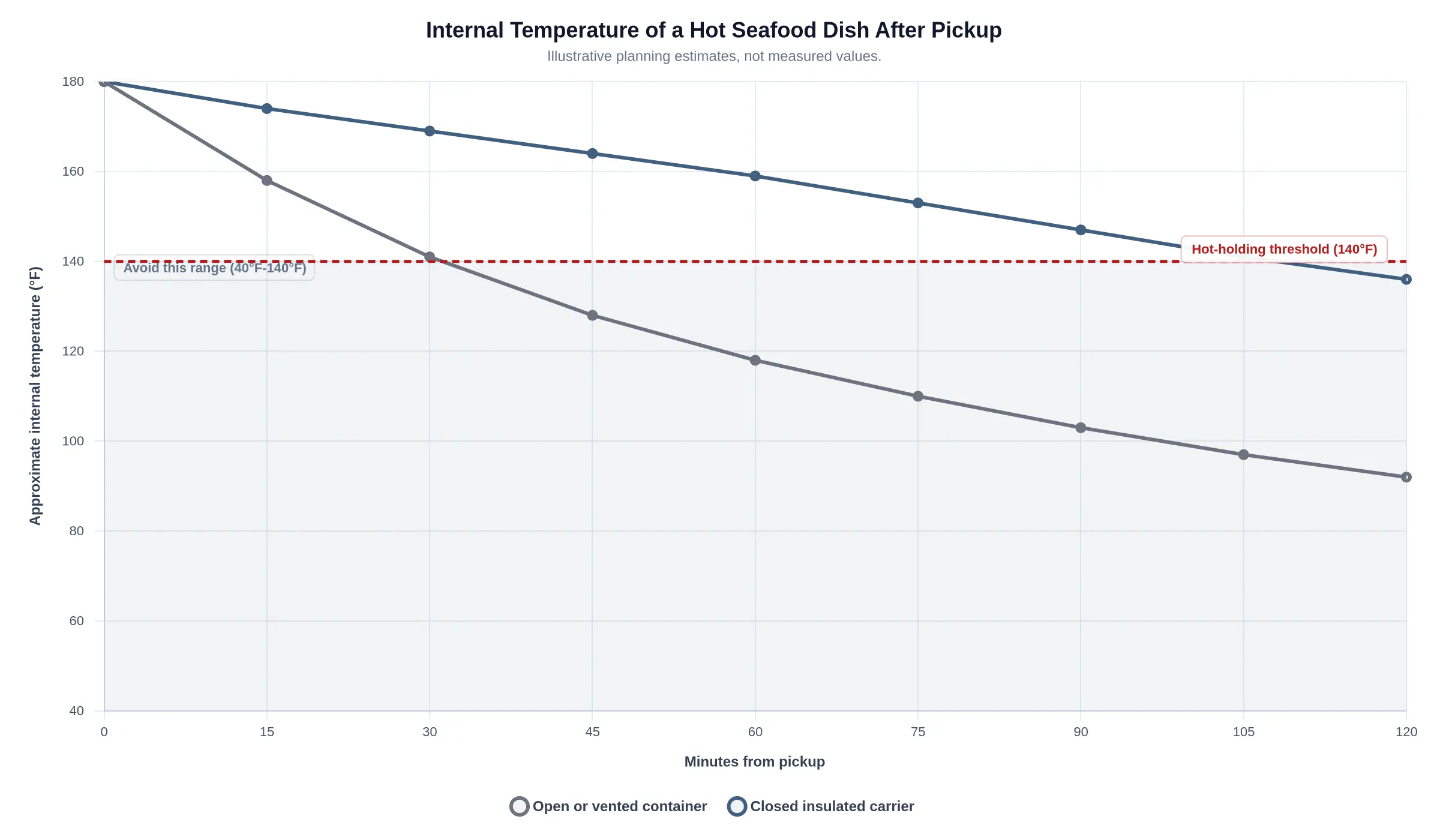
Chart caption: read the curves as a planning tool. If your drive home is longer than the point where your container’s line crosses 140°F, plan to vent, reheat, or choose a dish that travels better.
What the Curves Tell You
- Vented is for crispness, not for holding. A cracked lid keeps fried shrimp and fried oysters from steaming themselves soggy, and it also lets heat escape. Treat those dishes as short-hop food: eat within roughly half an hour of pickup.
- Insulated is for the long haul. A closed insulated carrier keeps a seafood casserole, bisque, or gumbo above 140°F for well over an hour, which covers a 20-to-40-minute drive plus table-setting time.
- Never park a dish in the 40°F to 140°F zone. The shaded band is where bacteria multiply fastest. If your dish has already dropped into it, eat it promptly or refrigerate it and reheat thoroughly rather than letting it drift there for hours.
Turn the Chart Into a Pickup Plan
Work backwards from the drive: estimate travel time, add 15 minutes for parking and handoff, then choose a container and dishes to match. If you are coordinating a holiday order, it also helps to know which Mayflower Seafood locations sit closest to your route, so the food spends more time hot and less time in the car. When in doubt, ask for the dish packed hot in an insulated carrier and keep a cooler with a hot pack in the trunk as backup.
Pickup Day Checklist for a Thanksgiving Meal To Go
Holiday pickup slots disappear fast, and the last thing you want on Thanksgiving morning is a surprise at the counter. Fifteen minutes with this list keeps the order on schedule, from the moment you confirm it to the moment the cooler lid closes.
- Confirm your pickup window. Check your confirmation for the exact slot, call the restaurant if anything looks unclear, and note when the line tends to be shortest.
- Confirm contents and headcount. Read the itemized list aloud, match portions to the number of guests, and add a side or dessert if the count has crept up since you ordered.
- Pack carriers and gel packs. Sturdy boxes or a cooler with frozen gel packs, plus a folded blanket to insulate the hot bag.
- Clear refrigerator and oven space. Empty a few shelves and one middle rack before you leave, so cold dishes go straight in and hot ones can be reheated without rearranging dinner.
- Plan the drive and a parking option. Map the route, pick a lot or side street with an easy exit, and allow extra time for holiday traffic near the restaurant.
- Arrive within the window. Show up near the start of your slot rather than the end, which keeps hold times short.
- Inspect and count at the counter. Lift each lid, tick off every dish against the receipt, and flag anything missing before you walk away.
- Request separate packaging for sauces and fried items. Gravies, sauces, and crispy fried seafood travel better in their own containers.
- Load cold items first, hot items last. Settle chilled salads and raw-bar items into the cooler first, then stack hot entrées on top and keep the hottest dishes closest to the heat source.
- Head directly home. Skip the detour and the grocery stop. Most dishes hold their quality for a limited stretch, and every extra minute takes something off it.
Staple the checklist to your order confirmation so the window, the item count, and the packaging requests live in one place.
Ordering Timelines and Lead Times for Thanksgiving Dinner to Go
Thanksgiving takeout runs on a schedule that starts weeks before the holiday, and seafood adds a wrinkle: most kitchens work with fresh product that has to be ordered, delivered, and prepped in a short window. Here is how the timeline usually breaks down and what is worth confirming at each stage.
Three to Four Weeks Before: Pick Your Dishes and Note the Cutoffs
Holiday seafood orders typically open three to four weeks ahead and close seven to ten days before Thanksgiving, sometimes earlier for whole fish and shellfish platters. Popular items sell out first because supply is genuinely fixed. Oyster beds and crab fisheries do not scale up for one Thursday, shrimp and lobster tails are allocated to restaurants well in advance, and fried or stuffed dishes take hours of hand prep that a kitchen can only repeat so many times a day. Whole fried fish, crab legs, shrimp trays, and oyster dressings are the usual early casualties. If your table has one dish nobody will negotiate on, book it in this window rather than waiting to finalize the full menu. Readers checking a specific store’s holiday ordering details can look up Mayflower Seafood in Reidsville, NC.
About Two Weeks Out: Place the Order and Confirm the Basics
When you place the order, get five things read back to you: the exact pickup window, the complete dish list including sides and sauces, how everything will be packaged (sealed trays, vented lids, ice packs for cold items), reheating instructions for each dish, and the payment arrangement. Ask whether the balance is due when you order or when you collect. Holiday slots usually run in fifteen- to thirty-minute blocks, with the heaviest demand late morning through early afternoon. A slightly earlier or later window often means a calmer pickup and food that has not been sitting under a heat lamp.
Five to Seven Days Before: Adjust Headcount and Add-Ons
This is the practical checkpoint. Confirm the final guest count, add a side or a second shrimp order if the list grew, and flag allergies or dietary needs now rather than at the counter. It is also the moment to ask whether the kitchen can pack cold items separately from hot ones, which matters if your drive runs longer than twenty minutes.
Two to Three Days Before: Reconfirm the Details
Call and reconfirm the pickup window, your order number, the dish list, and the payment method. Confirm who is authorized to collect the order if plans change, and ask again about reheating instructions, since a printed sheet beats a verbal rundown at the door. Mention it if you will need help carrying trays to the car. Ordering from the Darlington location? Cutoff dates and slot availability are set store by store, so verify with that kitchen directly.
The Morning Of: Pack for the Drive
Bring a cooler with a couple of ice packs, plus a folded blanket or towel to keep hot trays insulated. Know your hold times: fried seafood is best within thirty to forty-five minutes, baked and steamed seafood travels comfortably for about an hour, and cold items like shrimp cocktail and salads hold in a cooler for the whole trip.
If a Preferred Seafood Dish or Pickup Window Is Unavailable
Take the substitution. Kitchens usually propose something comparable, such as baked instead of fried, or a shrimp or crab cake platter in place of a sold-out specialty, and those swaps are typically the same quality in a different prep style. If your window is full, ask about an earlier slot, one after the rush, or splitting the order across two windows. Confirm the swap in writing so the final dish list matches what you expect to serve.
Frequently Asked Questions About Thanksgiving Dinner To Go
How early should a Thanksgiving dinner to go order be placed?
Two to three weeks ahead is comfortable at most restaurants, and the cutoffs usually fall seven to ten days before the holiday. The dishes that disappear first are the ones that take longest to prepare: whole turkeys, crab legs, and large chilled shrimp platters. Day-before calls are worth making, but expect limited sides and no choice of time slot. If you are ordering from a specific branch, spend five minutes checking recent location feedback before ordering, since holiday staffing and volume vary by store.
Can a holiday meal be picked up the day before and served the next day?
Yes, and many hosts prefer it, because it turns a stressful Thanksgiving morning into a calm reheating session. Chilled shrimp and shellfish platters, chowders, soups, stuffing, and casseroles all hold well for 24 hours at 40°F or below. Fried items are the exception, since they lose their crunch overnight and need a short oven refresh rather than a microwave pass. Label everything with the pickup date so you know what to reheat first.
How long can hot seafood dishes sit before serving?
Plan on two hours at room temperature at most, and cut that to one hour if the room is above 90°F. For longer spreads, hold hot seafood at 140°F or higher in a chafing dish, slow cooker, or low oven, and replenish rather than stacking fresh portions on older ones. Shrimp, scallops, and flaky fish keep cooking as they sit, so the shorter the hold, the better the texture on the plate.
Do fried seafood dishes stay crisp on the drive home?
They stay crisp for roughly 20 to 30 minutes if the container is vented so steam can escape. Sealed lids trap moisture and turn a crust soft within minutes, so ask the kitchen to leave an edge open or pack in boxes with air holes. Keep sauces on the side, and if the drive runs long, revive the coating in a 375°F oven for five to eight minutes instead of using a microwave.
Are chilled shrimp and shellfish platters safe to hold in a cooler?
Yes, provided the cooler keeps everything at 40°F or below for the entire trip. Layer ice or frozen gel packs above and below the platter, keep the lid closed, and park the cooler in the shade rather than a warm trunk. Drain melted ice before serving so shrimp are not sitting in water, and discard anything left out for more than two hours.
What should be confirmed when scheduling a pickup window?
Four things: the exact window, the full contents of the order, the payment method on file, and where to park or whether curbside service is available. Ask whether reheating instructions are printed in the bag, and save the location’s direct phone number in case traffic pushes you past your slot. Clear pickup windows are the difference between a smooth handoff and a 20-minute wait in a crowded lobby.
Does a larger order need a different pickup window?
Yes. Orders feeding a crowd are usually packed in multiple bags and coolers, which takes longer to assemble, so ask for a window 15 to 30 minutes earlier than you would for a family of four. Stagger large orders into two pickup times if you can, and bring a cooler or two so hot dishes and chilled platters never share space. Mention the headcount when booking so the kitchen can assign enough staff to your slot.
How should leftovers be stored and reheated?
Cool leftovers within two hours, transfer them into shallow containers, and refrigerate at 40°F or below for up to three to four days. Reheat seafood gently to 165°F, using a covered oven at 325°F or a gentle stovetop reheat for soups and chowders. Fried items do best on a sheet pan in a hot oven, and shrimp platters should be eaten cold rather than reheated.
Which seafood dishes should not be ordered for a long drive?
Skip anything built on a delicate crisp crust, raw oysters on the half shell, and hot crab dips if your drive exceeds 45 minutes. Fried shrimp and thin fillets suffer most, and a hot buttered lobster roll turns soggy fast. Build the order around chilled platters, steamed crab legs, chowders, bisques, and baked casseroles instead.
How do I keep a big order organized once I get home?
Unpack in the order you will serve. Chilled platters go straight into the refrigerator and hot items into a warm oven set to 150°F to 170°F. Keep sauces, dressings, and garnishes in a single bin so nothing goes missing at the last minute, read the reheating notes before the kitchen gets busy, and set a timer for each dish.
The Takeaway: A Practical Plan for Thanksgiving Dinner to Go
Ordering Thanksgiving dinner to go comes down to logistics, not luck. The dish mix should match the length of the drive. On a short hop across town, crisp items and delicate seafood can still arrive in good shape. On a longer drive, the sturdier sauce-based dishes deserve the room in the bag. Getting that pairing right does more for the finished plate than any last-minute trick in the kitchen.
Timing is the second decision, and the one most people rush. Book the pickup window against the moment you plan to serve, not against when you feel like leaving the house, and work backwards through carving, plating, and the buffer you always end up needing. Popular windows fill early on the holiday itself, so a reserved slot protects the whole schedule.
Once the bag is in the car, hold times take over. That clock starts at handoff and keeps running through every red light and detour. Reheating order matters just as much: dense, sauce-heavy dishes go in first, while lighter seafood needs only a brief pass so it stays tender. If you have not settled on a location, check holiday takeout availability early, since menus and slots change fast this time of year.
Four steps carry the plan:
- Match the dish mix to your drive length.
- Book the pickup window against your serving time.
- Respect the hold-time clock from handoff onward.
- Reheat in the right order.
Confirm your pickup window and finalize the dish list with the restaurant this week.