
Why Hotel and Casino Seafood Restaurants Open on Thanksgiving While Independents Stay Dark
Most independent restaurants close on Thanksgiving. A far larger share of hotel and casino seafood restaurants stay open, fully staffed and often heavily booked. The gap is not about holiday goodwill. It comes down to cost structure, captive demand, and the scale of a corporate operation.
The people who actually make this call – food and beverage directors, restaurant and casino operators, hospitality investors – are weighing whether a holiday service adds to the bottom line or quietly erodes it. For an independent, opening on Thanksgiving usually means holiday wage premiums, a thin margin, and a fixed cost base too heavy to dilute with a single busy evening, so staying closed is often the better play. For a hotel or casino, the calculus inverts: the seafood dining room sits inside a property with guaranteed overnight guests, gaming traffic, and a shared labor pool, which turns the holiday into incremental revenue rather than a standalone wager. That difference shapes everything from staffing to menu design in high-volume seafood dining operations, where holiday covers are absorbed with far less disruption than a single-site independent could sustain.
Three forces drive the split: the fixed-versus-variable cost structure, captive versus discretionary demand, and the operational scale that makes corporate holiday service profitable. Each is covered below.
The Fixed-Cost vs. Variable-Cost Rationale
A hotel or casino seafood restaurant opens on Thanksgiving because of its cost structure, not its sentiment. These operations carry a heavy fixed-cost base – property overhead, contractual and salaried labor, utility base charges, and mortgage or lease obligations – that accrues whether the dining room serves guests or sits dark. Because those costs are already committed and sunk, the real question is not whether the restaurant is profitable on the day, but whether holiday service generates positive marginal contribution.
| Cost category | Hotel / casino seafood restaurant | Independent seafood restaurant |
|---|---|---|
| Occupancy overhead | Fixed, carried 365 days | Fixed or semi-variable |
| Labor | Contracted and salaried, largely fixed | Hourly, scheduled to demand (variable) |
| Utilities | Demand-charge base (fixed) | Usage-driven (variable) |
| Food and disposables | Variable, per cover | Variable, per cover |
Take a representative casino seafood restaurant carrying roughly $22,000 in daily fixed cost. Incremental variable cost on Thanksgiving runs near $26 per cover against an average check of $68, a contribution margin of about $42 per cover, or 62 percent. Once the modest incremental opening cost is covered, nearly every additional cover goes toward fixed-cost recovery, so the break-even seat count needed to justify opening sits well below the break-even for a normal trading day.
| Metric | Value |
|---|---|
| Daily fixed cost carried | ~$22,000 |
| Average check | ~$68 |
| Variable cost per cover | ~$26 |
| Contribution margin per cover | ~$42 (62%) |
| Incremental break-even covers | ~130-160 |
For independents, the arithmetic inverts. Most costs are variable: hourly labor matched to covers, food purchased against a forecast, little salaried overhead, and minimal contractual drag. When an independent closes, idle capacity becomes genuine savings instead of absorbed cost, so staying shut lowers total spend. Opening for a thin holiday crowd can push toward negative marginal contribution once premium holiday labor and spoilage are priced in.
That contrast explains the behavior. Inside a casino seafood operation, a committed fixed-cost base creates a structural incentive to keep assets producing even at reduced covers, because each incremental holiday cover contributes so much. Where those fixed costs are already sunk, the contribution margin on Thanksgiving covers easily clears the low incremental variable cost, and the break-even seat count stays low. For an independent, the same contribution margin rarely covers the premium labor and waste of a holiday shift, which makes closing the rational use of capacity for independent seafood restaurant operations.
| Operator Type | Cost Structure | Labor Flexibility | Demand Source | Revenue Management Capability | Predominant Thanksgiving-Decision |
|---|---|---|---|---|---|
| Large Casino-Hotel Seafood Restaurant | High fixed costs spread across a sprawling property; seafood is one revenue line in a diversified portfolio | Low flexibility; unionized or salaried staff on scheduled shifts that must be covered regardless of covers | Captive in-house guests, casino traffic, and holiday travelers already on-property | Sophisticated; dynamic pricing, pre-fixe holiday menus, and centralized F&B analytics | Open – fixed overhead and guest capture make darkening the outlet costlier than running it |
| Upscale Hotel Seafood Outlet | Moderate-to-high fixed costs absorbed by hotel P&L; rent, utilities, and labor carried by the parent asset | Moderate flexibility; can flex to a skeleton crew but bound by brand service standards | In-house hotel guests plus local holiday diners booking a destination meal | Structured; standardized forecasting and brand-mandated holiday programming | Usually open – brand consistency and guest expectation outweigh thin holiday margins |
| Independent Fine-Dining Seafood Restaurant | Concentrated fixed costs borne by a single owner; no parent portfolio to absorb losses | High flexibility; owner-operator can choose to close and shift staff to paid time off | Discretionary reservations and occasion diners with no captive demand pool | Limited; often intuition-led pricing and limited holiday menu engineering | Frequently closed – thin holiday demand cannot justify full staffing costs |
| Neighborhood Independent Seafood Restaurant | Lean, variable cost base with tight margins and no cushion for slow holiday services | Highest flexibility; small teams can close with minimal disruption and no brand penalty | Local walk-ins and regulars who typically dine at home on the holiday | Minimal; pricing set by local competition and gut instinct | Predominantly closed – low expected covers and high opportunity cost of opening |
Why the split exists: operators tethered to fixed costs and captive holiday demand find opening economically rational, while independent seafood restaurants that carry overhead alone and serve a discretionary local base find it rational to stay dark – which is why independent seafood operators are far more likely to close on Thanksgiving even when their year-round offering is just as strong.
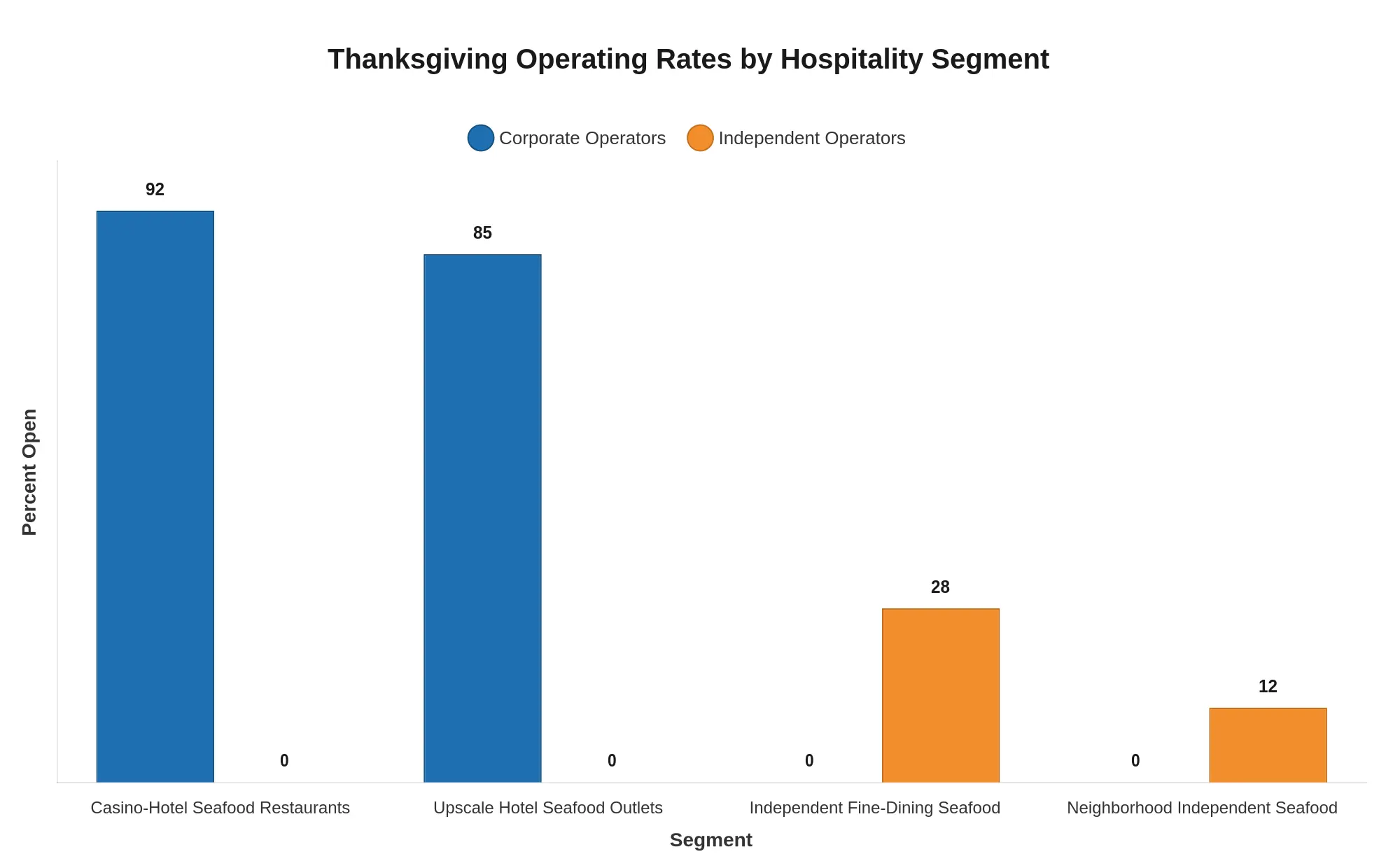
Thanksgiving Operating Rates by Hospitality Segment
The divergence is stark: casino-hotel seafood restaurants (92%) and upscale hotel seafood outlets (85%) stay almost fully open, while independent fine-dining (28%) and neighborhood independent seafood restaurants (12%) go dark. That gap reflects structural advantage more than appetite. Corporate operators absorb holiday labor premiums, draw on captive hotel and casino guests, and treat the holiday as a premium-revenue event. Independents face thin margins, an absent owner-operator, and too little walk-in volume to justify doubling labor costs. Illustrative values.
Labor and Staffing Economics Behind Feasible Holiday Service
In hotels and casinos, holiday staffing is less a question of whether labor exists than of how it is contracted and deployed. Unlike independents, these operations carry a baseline of salaried staff – executive chefs, sous chefs, banquet managers, floor supervisors – whose compensation is fixed and already committed regardless of covers served. Opening on Thanksgiving adds volume to an existing cost base rather than a new fixed burden.
Scheduling flexibility compounds that advantage. On-call pools, staggered shifts, and cross-trained kitchen brigades whose members rotate between pantry, saute, and cold stations let a property staff a holiday without new hires. Operating a full-service seafood menu benefits directly: the same brigade that turns out a la carte plates can pivot to banquet platters. Unionized properties add another layer of predictability, since collective agreements set pay floors and defined overtime multipliers, so managers can forecast the marginal cost of each added shift with precision. When overtime is priced at a known premium, extending holiday service becomes an arithmetic exercise in contribution margin rather than a gamble.
Overtime economics favor the house. Salaried staff absorb coordination and supervision at no incremental wage cost, and hourly overtime triggered by only part of the workforce is offset by premium holiday pricing and higher average checks. The casino seafood restaurant labor model treats Thanksgiving as incremental use of sunk capacity.
Independents lack those buffers. A small operator runs a flat roster with fixed minimum staffing; when two line cooks call out on a holiday, there is no on-call list, no cross-trained brigade, and no salaried layer to absorb the gap. Absenteeism becomes a closure event rather than an inconvenience. The gap is not effort or intent – it is the depth and design of the labor system.

The Structural Operating Drivers Behind Holiday Openings
For hotel and casino seafood restaurants, opening on Thanksgiving is rarely an act of sentiment; it follows from structural operating drivers embedded in how integrated resort properties run, from captive demand curves to centralized seafood restaurant operations.
- Captive in-house guest demand: holiday travelers, convention attendees, and casino loyalty members already staying on property need somewhere to dine when off-site independents go dark.
- Casino floor traffic and cross-selling: an open dining room keeps players circulating before and after meals, turning a plate of oysters into incremental gaming and beverage revenue.
- Bundled resort experiences: Thanksgiving packages pair rooms, entertainment, and dining credits, so the seafood venue becomes a fixed, prepaid part of a guest itinerary.
- Corporate revenue-management systems: centralized forecasting and dynamic pricing tools model holiday demand, flagging the dinner daypart as worth capturing rather than surrendering.
- Fixed-cost absorption: rent, labor, utilities, and insurance accrue whether or not the doors open, so holiday covers spread already-committed overhead across more revenue.
- Brand and guest-recovery obligations: flagship seafood venues anchor a property’s reputation, and closing one risks disappointing high-value guests the resort cannot afford to lose.
- Centralized seafood procurement: group purchasing and established cold-chain contracts let these kitchens secure premium product at scale, which makes a special holiday menu economically viable.
For hotel and casino seafood restaurants, then, Thanksgiving opening is less a seasonal gamble than a calculated response to captive demand, sunk costs, and corporate systems that make staying dark the riskier commercial choice.
Revenue Management and Demand Capture on Thanksgiving
Hotel and casino seafood restaurants treat Thanksgiving as a revenue-management problem rather than a service problem. Their holiday revenue management playbook depends on centralized demand data and controlled distribution, two assets independents rarely have.
Dynamic pricing of holiday prix-fixe menus. Integrated operators price multiple seatings at different tiers, raising rates for prime dinner windows and discounting earlier afternoon covers to smooth demand. A fixed menu makes food cost and labor predictable, so margin can be modeled per cover before service begins.
Table-time optimization. Resort and casino systems cap dining durations and stagger reservations to maximize turns without degrading the experience, converting a finite dining room into a higher-yield asset across the holiday block.
Demand forecasting from reservation systems. When bookings, hotel occupancy, and loyalty data flow into a single platform, operators forecast Thanksgiving dining demand with high confidence and align staffing, prep, and pricing to it. Forecasting accuracy, not marketing spend, is what stabilizes holiday P&L.
Bundling with room packages and gaming promotions. Room-and-dinner bundles and complimentary-dining incentives tied to casino play push captive guest demand straight into the restaurant, pre-selling covers before the holiday arrives.
The decisive difference is the ability to convert leisure and travel demand into dining covers. Integrated venues such as these hospitality-embedded seafood operations intercept guests who are already on-property, so demand is captured rather than competed for. Independents lack that captive base and the centralized data to forecast it, leaving them unable to predict whether holiday seats will fill. Without visibility into travel patterns or a lodging funnel feeding reservations, they absorb the full holiday labor and inventory risk against uncertain walk-in turnout. That asymmetry, more than menu quality, is why many independents stay dark on Thanksgiving.
| Lever | Hotel/Casino Seafood Restaurant | Independent Restaurant |
|---|---|---|
| Menu pricing | Tiered, dynamic prix-fixe | Static, single price point |
| Reservations | Centralized and forecastable | Fragmented, walk-in heavy |
| Demand source | Captive on-property guests | External and uncertain |
| Bundling | Room plus gaming packages | None or limited |
| Risk posture | Pre-sold covers | Unhedged inventory |
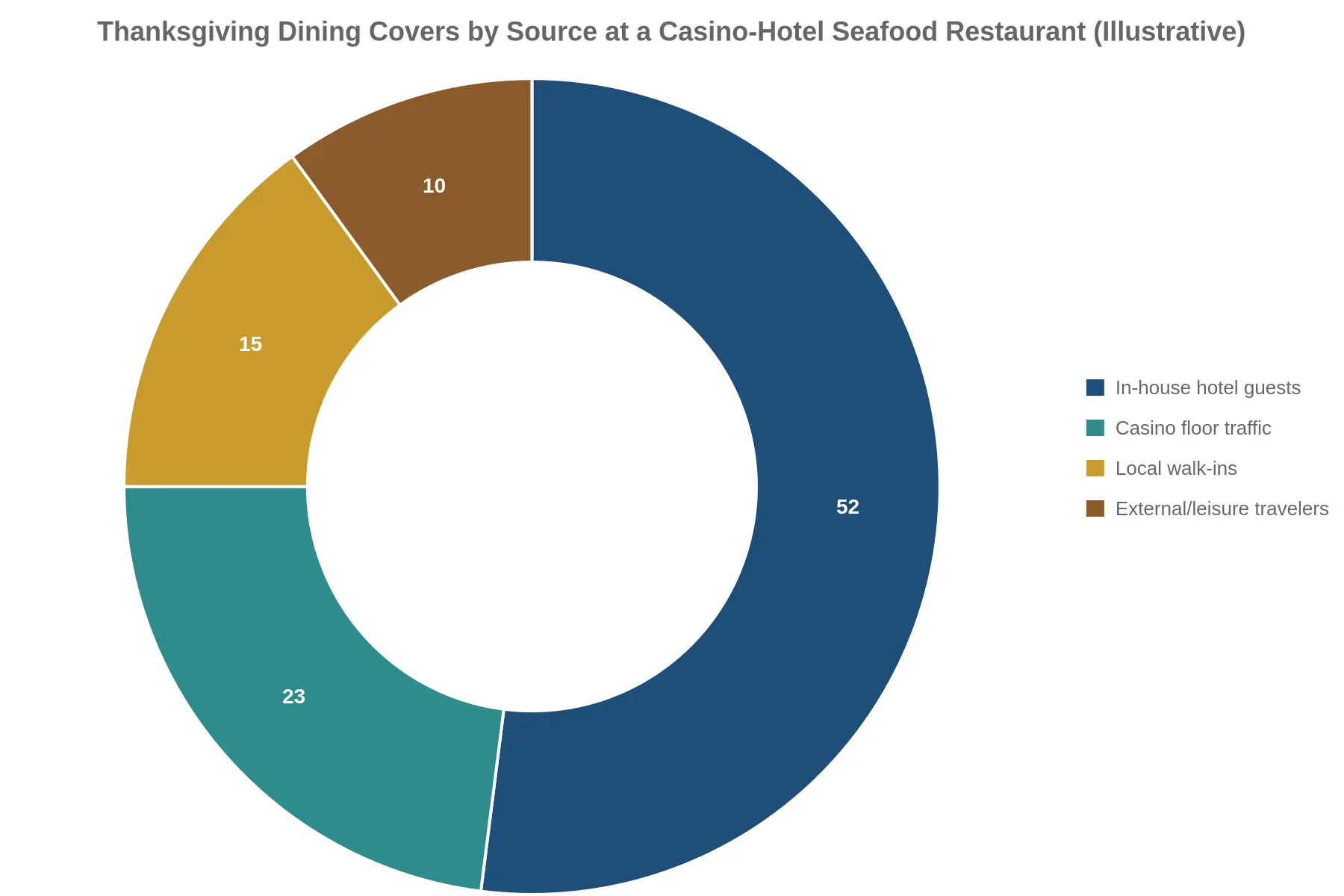
Figure: Thanksgiving Dining Covers by Source (Illustrative)
Illustrative composition of a typical casino-hotel seafood restaurant’s holiday dinner service.
| Source Segment | Share of Covers |
|---|---|
| In-house hotel guests | 52% |
| Casino floor traffic | 23% |
| Local walk-ins | 15% |
| External/leisure travelers | 10% |
Analytical caption: As the doughnut chart shows, roughly 75% of Thanksgiving dining covers are captive-derived – drawn from in-house hotel guests (52%) and casino floor traffic (23%) already on the property. That captive-derived majority de-risks the opening decision. Unlike an independent operator who must generate every Thanksgiving cover from discretionary external demand, the casino-hotel seafood restaurant starts the holiday with a predictable on-property base whose room, play, and celebration needs keep them on-site. That demand floor supports confident staffing, seafood pre-ordering, and menu build-out, while local walk-ins (15%) and external/leisure travelers (10%) layer incremental upside on top.
Risks and Counterarguments: When Staying Dark Is the Rational Choice
Opening on Thanksgiving is not automatically accretive, and the strongest operators treat the decision as a margin test rather than a tradition. The first counterargument is margin dilution. Holiday demand skews toward fixed-price, family-style menus sold at price points guests anchor against the cost of cooking at home rather than against a restaurant’s normal a la carte check. When a venue trades a $72 seafood entree for a $49 prix-fixe cover, revenue per occupied seat can fall even as cover counts rise, and on a low-multiple holiday that compression is hard to offset with volume alone.
Labor is the second constraint. Holiday premiums, overtime, and higher no-show rates on working shifts push variable labor cost well above baseline, and they do so on the day a venue can least afford a thin crew. The result is the holiday operating risk hospitality managers track closely: compressed service windows, uneven pacing, and a quality drop that shows up as comps, remakes, and recoveries rather than complaints. One poorly executed holiday can erode guest trust that drives the rest of the year.
Cannibalization is the third risk. Guests who would otherwise book a higher-value weekend cover may shift their visit to Thursday at a lower ticket, so incremental holiday revenue partly replaces revenue that already existed. Then there is the tradition trap: opening because the venue always has, without evidence the day clears its fully loaded cost, turns a ritual into a recurring loss.
That is why many independent restaurants closed for the holiday stay dark deliberately, banking the fixed-cost savings and protecting team goodwill.
| Signal | Favors staying dark | Favors opening |
|---|---|---|
| Check average | Holiday ticket below 70% of normal | Fixed-price at or above normal check |
| Labor cost | Premiums push labor past 38% of sales | High existing hotel or casino traffic absorbs cost |
| Ticket mix | Cannibalizes higher-value weekend covers | Adds covers without displacing weekend demand |
| Guest base | Local, price-sensitive, family-at-home | Captive guests, tourists, no home kitchen |
In practice, the math flips when a venue can hold holiday check average near its normal level, keep labor under roughly 35 to 38 percent of holiday sales, and draw from captive demand that would not have booked a weekend table anyway. Below those thresholds, staying dark is not inertia; it is disciplined capital allocation. Operators weighing a comparable Saturday-night model can look at how a steady seafood operation structures its covers to see whether holiday service fits the concept at all, as illustrated by Mayflower Seafood’s approach to daily seafood service.
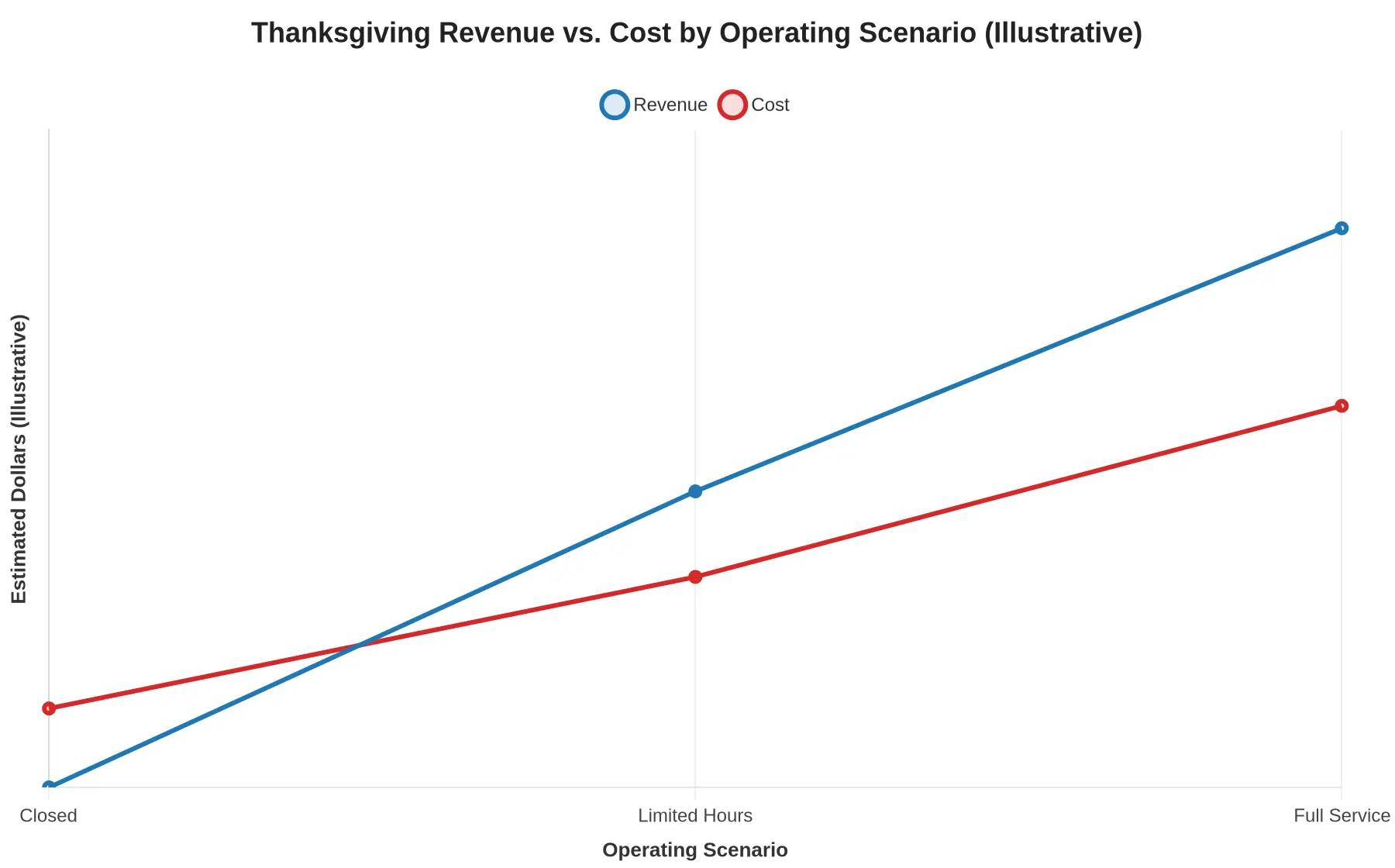
Chart: Thanksgiving Revenue vs. Cost by Operating Scenario (illustrative values, USD).
| Operating Scenario | Revenue (Illustrative) | Cost (Illustrative) | Net Result |
|---|---|---|---|
| Closed | $0 | $12,000 | -$12,000 |
| Limited Hours | $45,000 | $32,000 | +$13,000 |
| Full Service | $85,000 | $58,000 | +$27,000 |
Caption: This chart traces how a holiday operating scenario revenue projection moves against cost for a high-fixed-cost venue such as a hotel or casino seafood restaurant. The biggest outlays – rent, staffing commitments, utilities, inventory readiness – exist whether or not the doors are open, so the Closed scenario still absorbs roughly $12,000 in unavoidable cost with zero revenue. The decisive point is Limited Hours: moving from Closed to Limited Hours adds about $45,000 in incremental revenue against only about $20,000 in incremental cost, which turns the loss into a $13,000 contribution. Extending to Full Service widens the spread, adding another $40,000 in revenue for roughly $26,000 in added cost. The crossover happens early: even a modest holiday opening captures enough margin to offset fixed costs that would otherwise be sunk.
Frequently Asked Questions: Thanksgiving Seafood Dining
Why do hotel and casino seafood restaurants on Thanksgiving operate when independent seafood restaurants stay dark?
Because they function as captive-amenity venues, not standalone dining destinations. A hotel or casino already carries fixed costs – leases, utilities, security, a full culinary brigade – whether its restaurants open or not. Closing on a major travel holiday leaves those costs unrecovered and denies on-property guests a meal. Holiday service extends rooms and gaming revenue rather than standing alone as a profit center.
Why are most independent restaurants closed on holidays?
Holiday service inverts their cost base. Independents rely on walk-in volume, and Thanksgiving pulls customers toward home cooking and family tables. A single-day opening forces holiday wage premiums, overtime, and a skeleton crew against soft, unpredictable demand. With no lodging or gaming revenue to absorb the risk, the downside outweighs the upside, so staying dark is the rational default.
Is Thanksgiving profitable for high-fixed-cost venues?
It is typically margin-neutral or only modestly positive. Large operators rarely treat the day as a major profit driver. They use it to protect guest satisfaction, avoid turning away in-house guests, and keep staff hours stable. The return shows up as loyalty and repeat visits across the year, not as a single-night windfall.
How is staffing handled for holiday service?
These venues plan weeks ahead. They publish holiday schedules early, rotate coverage so the burden is shared, and offer premium pay or comp time to volunteers. Cross-trained staff from other outlets fill gaps, and a fixed-price menu trims the number of cooks needed. The goal is reliable coverage with minimal overtime exposure.
Could independents test a Thanksgiving opening?
The safest path is a limited pilot: a reservation-only fixed-price menu, shortened hours, and a reduced crew. Lean on existing shellfish inventory and prep-ahead dishes that limit waste. Operators studying how established venues structure holiday service and bookings can look to examples like Mayflower Seafood Winston-Salem before committing to full holiday hours.
Does Thanksgiving seafood dining attract a different guest mix?
Yes. The holiday skews toward travelers, hotel guests, and groups looking for a relaxed alternative to turkey. That mix values convenience and atmosphere over bargain pricing, which can support a higher check average – a key reason hotel and casino seafood restaurants on Thanksgiving can justify opening when independent restaurants closed on holidays cannot.
The Bottom Line: Structure, Not Sentiment, Drives the Thanksgiving Split
The Thanksgiving open/closed divide between corporate and independent seafood operators is not about passion or stubbornness. It follows from three structural forces: divergent cost structures, captive demand, and revenue-management capability. Hotels and casinos carry fixed labor, utilities, and debt-service obligations whether the dining room is full or not, so a closed kitchen still bleeds cash. Their guest base is largely captive, and their pricing teams can model holiday demand, justify premium menus, and staff for it. Independents rarely have any of those advantages, which is why staying dark is often the rational choice rather than the emotional one.
Looking ahead, these forces could pull in either direction. Tightening labor markets and rising holiday wage premiums will keep pressuring smaller operators and may widen the gap. The same pressure is pushing dynamic pricing tools and flexible reservation systems into the mainstream, and as those tools get cheaper, independents may gain the forecasting power hotels have long taken for granted. Consumers, meanwhile, increasingly expect a curated holiday experience – a shift that rewards operators who can deliver reliably.
For F&B directors and independent owners, the takeaway is to treat Thanksgiving as a data decision, not a tradition: model your true break-even covers, test reservations early, and price to your cost reality. Operators looking for a benchmark of how a seafood concept anchors holiday traffic can study this Winston-Salem seafood restaurant as a reference point. The winners among hotel and casino seafood restaurants on Thanksgiving will be those who plan around their economics, not their instincts.