
Introduction and Scope
Condenser water reset means raising or lowering the condenser water supply temperature setpoint in response to the building’s cooling load and the ambient wet-bulb conditions. In a water-cooled plant, chillers reject heat into a condenser water loop, and the cooling towers dissipate that heat to the atmosphere. Rather than holding the supply temperature at a single fixed design value all year, reset lets the setpoint move with the conditions the plant actually sees. The practice is caught in a familiar tension: any change to that setpoint shifts energy between two major consumers, chiller energy and cooling tower energy.
The physics is easy to state. Colder condenser water improves chiller efficiency and lowers chiller energy, but it forces the cooling towers to work harder, which raises fan power. Warmer condenser water reverses that relationship: tower fan energy falls while chiller compressor power climbs. Neither direction is automatically better. The right setpoint depends on load, weather, equipment, and control strategy, not on one universal rule.
Who this article is for
This article is written for facility managers, energy engineers, and HVAC professionals who operate, tune, or evaluate water-cooled chiller plants. It assumes a working familiarity with chillers, condensers, cooling towers, and basic control sequences. The aim is not to prescribe one fixed setpoint but to explain how the governing variables interact, so that readers can reason clearly about their own systems.
The central question
The article addresses one question: how does resetting condenser water temperature trade chiller compressor energy against cooling tower fan energy? What follows examines what drives each side of the trade-off, how wet-bulb conditions and part-load operation reshape the equation, and why a setpoint that minimizes one energy stream may not minimize total plant energy.
Scope of the discussion
The scope covers water-cooled chiller plants served by open-circuit cooling towers. Within that boundary, we discuss how condenser water supply temperature relates to chiller efficiency, often expressed as kW/ton, and to tower fan power. We consider how ambient wet-bulb temperature, tower approach, load profile, and control sequencing influence the point at which total energy is lowest. We also note practical constraints that limit how far a reset can be pushed: chiller minimum condenser water temperature, surge limits, refrigerant and oil considerations, and the response time of the tower and piping system.
Air-cooled condensers, water treatment programs, and detailed cooling tower mechanical design are outside this discussion. The emphasis stays on the operational decision at hand: choosing a condenser water setpoint that reflects both the cooling load and the wet-bulb conditions, and understanding what that choice costs on the chiller side versus the tower side.
The Physical Principles Behind Condenser Water Reset
A chiller never really creates cold. It moves heat from where you don’t want it (the building) to where you can dump it (the outdoors). Condenser water reset is a negotiation about how hard you make the chiller and the cooling tower work to complete that journey. Get the physics right and there is energy to save; get it wrong and you simply move the cost from one machine to the other.
The refrigeration cycle’s heat rejection path
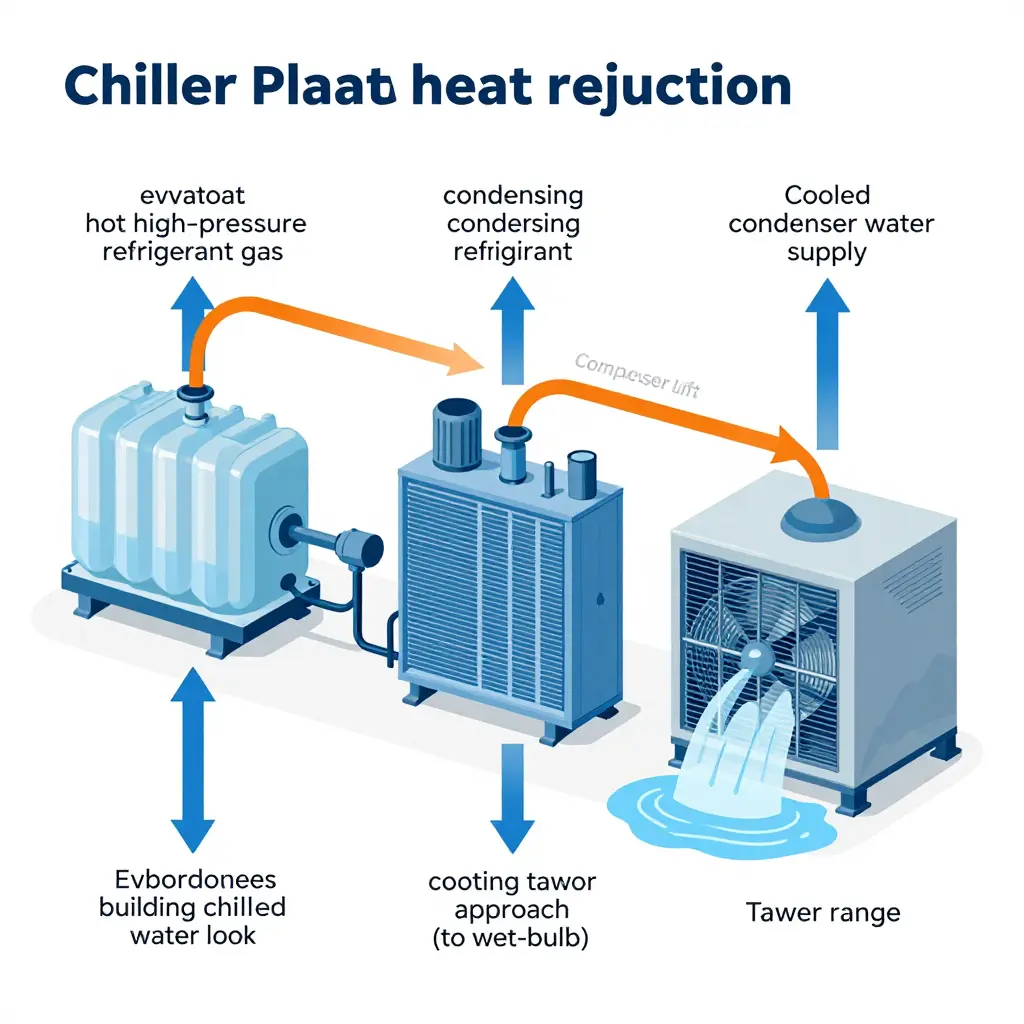
The refrigeration cycle begins in the evaporator, where refrigerant boils by absorbing heat from the building’s chilled water loop. The compressor then squeezes that low-pressure gas into a high-pressure, high-temperature vapor. That hot gas flows into the condenser, where it rejects its heat to the condenser water loop and condenses back into liquid. The cooling tower rejects that heat to the atmosphere through a mix of air movement and evaporation, and cooled water returns to the condenser to start again. Building to evaporator, to compressor, to condenser, to tower, to sky.
The Numbers That Define the Trade-Off
The trade-off turns on six terms that come up whenever you discuss the loop:
| Term | Plain-language meaning |
|---|---|
| Approach | How closely the leaving condenser water gets to the outdoor wet-bulb |
| Range | The temperature drop across the tower, from warm return to cool supply |
| Wet-bulb | The lowest temperature air can reach through evaporation alone; the tower’s theoretical floor |
| Lift | The pressure gap the compressor must overcome, tied to condensing vs. evaporating temperature |
| COP | Coefficient of performance; cooling delivered per unit of energy consumed |
| kW/ton | Energy used per ton of cooling, a practical efficiency metric |
Cooling tower approach and wet-bulb together set the coldest water the tower can realistically make. On a muggy 78°F wet-bulb day with a 5°F approach, the best you can expect is about 83°F of supply water, so resetting below that is chasing a temperature the tower can never reach.
Lower setpoint, leaner chiller
When you lower the condenser water temperature setpoint, the refrigerant condenses at a lower pressure, which shrinks the compressor lift. Less lift means less work for every ton of cooling delivered, so fewer kW/ton and a higher COP. Because chillers usually dominate plant energy, dropping the setpoint a few degrees can cut chiller power noticeably.
Higher setpoint, lighter tower
Colder condenser water also demands more tower airflow or more evaporation, so the tower fans work harder. Nudge the setpoint upward and the relationship flips: the chiller works harder while the tower relaxes. The sweet spot is where rising chiller power and falling tower power cross at the lowest total plant kW.
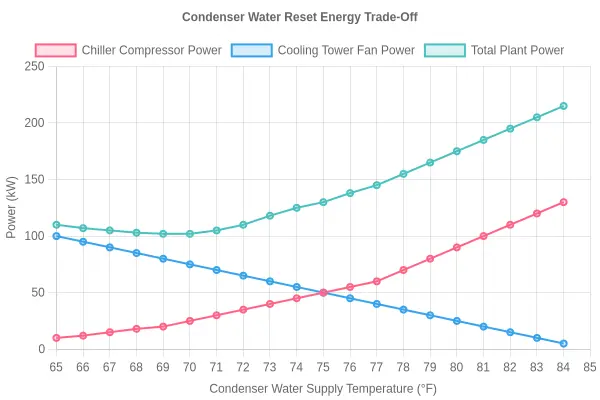
The curve tells the story. Neither extreme wins, and the minimum sits somewhere in the middle. That middle ground, found by measurement rather than guesswork, is what a well-designed reset strategy is built to locate.
Energy Outcomes Across Condenser Water Setpoints
The table below models a representative 500-ton water-cooled chiller plant and shows how chiller power, cooling tower fan power, and total plant power shift as the condenser water supply setpoint is raised from 65°F to 85°F in 5°F increments.
| Condenser Water Setpoint (°F) | Condenser Water Temp (°F) | Chiller Power (kW/ton) | Chiller Power (kW) | Cooling Tower Fan Power (kW) | Total Plant Power (kW) |
|---|---|---|---|---|---|
| 65 | 65 | 0.47 | 235 | 90 | 325 |
| 70 | 70 | 0.50 | 250 | 55 | 305 |
| 75 | 75 | 0.53 | 265 | 37 | 302 |
| 80 | 80 | 0.56 | 280 | 27 | 307 |
| 85 | 85 | 0.60 | 300 | 22 | 322 |
| Minimum total plant power: 75°F setpoint → 302 kW | |||||
Caption: As the condenser water setpoint is lowered, the chiller runs more efficiently and its power drops, but the cooling tower fans work harder to pull the water temperature down and their power climbs. Because the two effects move in opposite directions, total plant power reaches its minimum at an intermediate setpoint (75°F here) rather than at the coldest achievable temperature. For facility managers and energy engineers, the practical reading is to reset condenser water to the point where chiller savings and tower penalties balance, not to the lowest temperature the tower can reach.
The Chiller Side: Why Colder Condenser Water Cuts Compressor Power
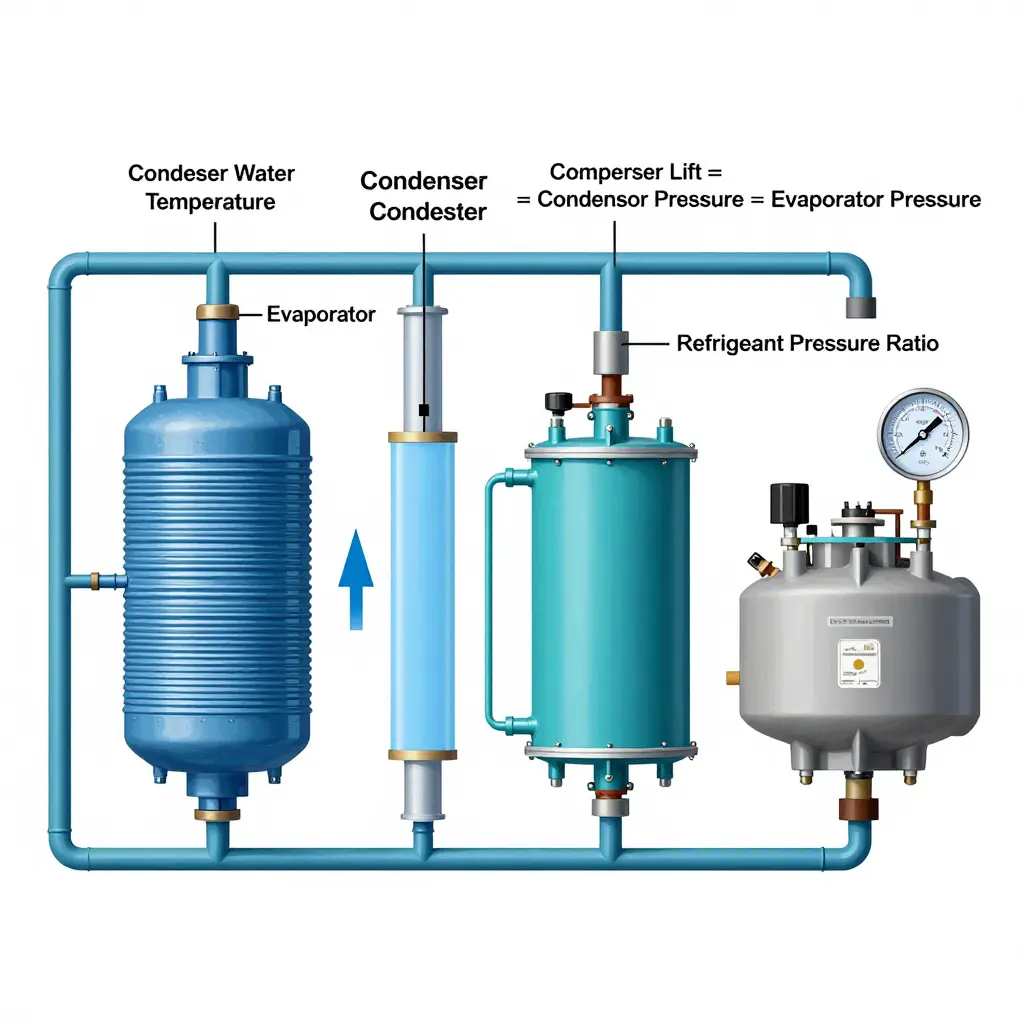
Colder condenser water is easier work for the chiller. In any vapor-compression machine, the condenser rejects the heat the evaporator pulled out of the building, and the warmer the condenser runs, the harder the compressor must push refrigerant vapor from the low-pressure evaporator into the high-pressure condenser. That pressure gap is the compressor lift, and it is the biggest single lever on chiller efficiency.
Compressor lift and the refrigerant pressure ratio
The compressor does meaningful work only when it has to raise refrigerant pressure. Lower the condenser water temperature and the condensing pressure falls, the lift shrinks, and the compressor needs less shaft power to move the same mass of refrigerant. Less lift also means a lower refrigerant pressure ratio (condensing pressure divided by evaporating pressure), which directly reduces compressor power for a given cooling output. Colder condenser water therefore means a smaller pressure ratio and fewer kilowatts burned per ton of cooling.
The rule of thumb, and its caveats
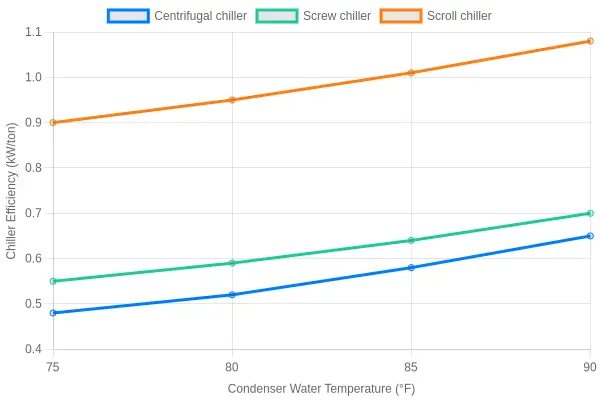
A commonly cited rule of thumb holds that chiller efficiency improves by roughly 1.5% to 3% for every 1°F (about 3% to 5% per 1°C) reduction in condenser water temperature. It is a useful planning number, but it is an average, not a promise. Real savings depend on the machine, the refrigerant, the entering condenser water temperature range, and the load, so confirm the figure against the manufacturer’s performance data or a measured baseline before you rely on those percentages.
How the effect varies by chiller type
| Chiller type | Sensitivity to condenser water temperature | Notes |
|---|---|---|
| Centrifugal | Highest | Strongest efficiency gain from lower lift, but surge risk at low load and low condensing pressure |
| Screw | Moderate to high | Good part-load performance; benefits still meaningful, less surge-prone |
| Scroll | Lowest | Smaller machines; equipment, piping and approach losses can dominate |
Centrifugal chillers reward condenser water reset the most, which is why they anchor most reset strategies. Screw machines sit in the middle. Scroll and small packaged units see the smallest percentage gains, so the reset is often not worth the added control complexity.
Part load and the point of diminishing returns
The benefit also depends on load. At high load, reducing lift cuts compressor power sharply; at light load, the effect flattens because fixed parasitic loads and minimum condensing-pressure limits start to dominate. There is a floor to how cold you can push condenser water: cooling tower approach temperature, minimum condensing pressure for proper expansion-valve and oil return, subcooling needs, and surge protection all stop you from going indefinitely low. Past that floor, extra tower fan and pump energy buys almost no additional chiller gain.
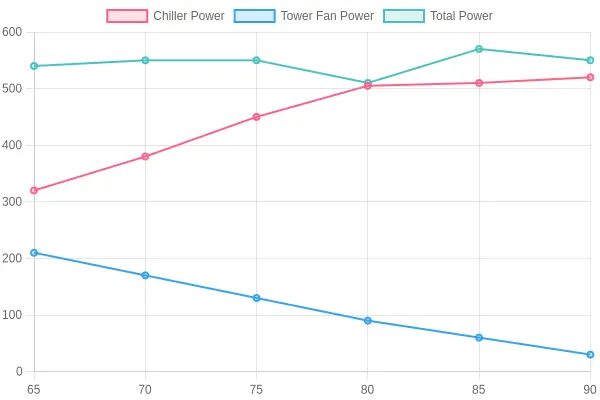
Seeing the Trade-Off: Power vs. Condenser Water Setpoint
Numbers in a spreadsheet can feel abstract, but a single curve makes the pattern visible. The chart below plots condenser water setpoint on the horizontal axis against power demand on the vertical axis. Three lines share the stage: chiller power, cooling tower fan power, and the total plant power that ties them together.
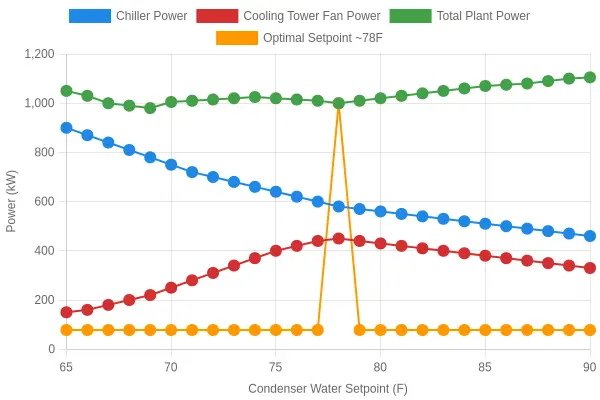
The blue line (chiller power) rises as the setpoint climbs. Warmer condenser water means greater lift across the compressor, so the chiller works harder. The red line (cooling tower fan power) moves the opposite way and falls as the setpoint rises, because warmer water is easier for the tower to produce. Each curve, on its own, argues for a different strategy.
The green line, the sum of the other two, is where the real insight lives. Because total plant power adds the two together, it forms a U-shaped curve. At low setpoints the tower fans drive total power up. At high setpoints the chiller takes over and pushes total power back up. Somewhere in the middle the two forces balance, and the total curve touches its lowest point at roughly a 78 F setpoint.
The dip marks the optimum, the setpoint where the combined energy of chillers and towers is minimized. Drift away from it in either direction and the plant pays more to deliver the same cooling.
Reading the Curves in Practice
When you walk into your plant, keep these patterns in mind:
- Low setpoint (65-70 F): Chillers run easily, but tower fans work hard. Total power is high.
- Mid setpoint (76-80 F): Chillers and towers split the load, and total power bottoms out.
- High setpoint (85-90 F): Tower fans coast, but the chiller penalty more than offsets that saving. Total power climbs again.
The exact location of the minimum shifts with outdoor conditions, load profile, and equipment characteristics. On a hot design day the ideal setpoint may fall near 75 F; on a mild shoulder-season day it might sit closer to 80 F. The shape of the U changes too, becoming tighter and steeper as loads rise.
This is why a fixed setpoint rarely wins. A reset schedule tuned to actual conditions lets you track the bottom of that U-shaped curve all year. For teams trying to shave peak demand and trim operating budgets, that continuous adjustment is one of the higher-return controls changes available. Understanding how the chiller and tower interact is also a useful first step before committing to a full energy upgrade program.
The Cooling Tower Side of the Trade-Off
Resetting condenser water temperature is really a negotiation with two machines at once. The chiller gets an easier job when the water is colder, but the cooling tower has to work harder to deliver it. That work shows up as cooling tower fan energy, and it is governed almost entirely by the ambient wet-bulb temperature and the approach you ask the tower to hold. Before you push the setpoint down, it pays to understand what the tower can realistically do.
Wet-Bulb: The Thermodynamic Floor
A cooling tower does not cool water with refrigeration. It cools water by evaporating a small fraction of it into the air stream, so the coldest water it can ever produce is bounded by the ambient wet-bulb temperature. Dry-bulb barely matters here; what matters is how much moisture the air can still absorb. On a humid day the wet-bulb climbs toward the dry-bulb, the driving force for evaporation shrinks, and the tower’s ability to reject heat falls off sharply.
Approach and Range: The Two Numbers That Matter
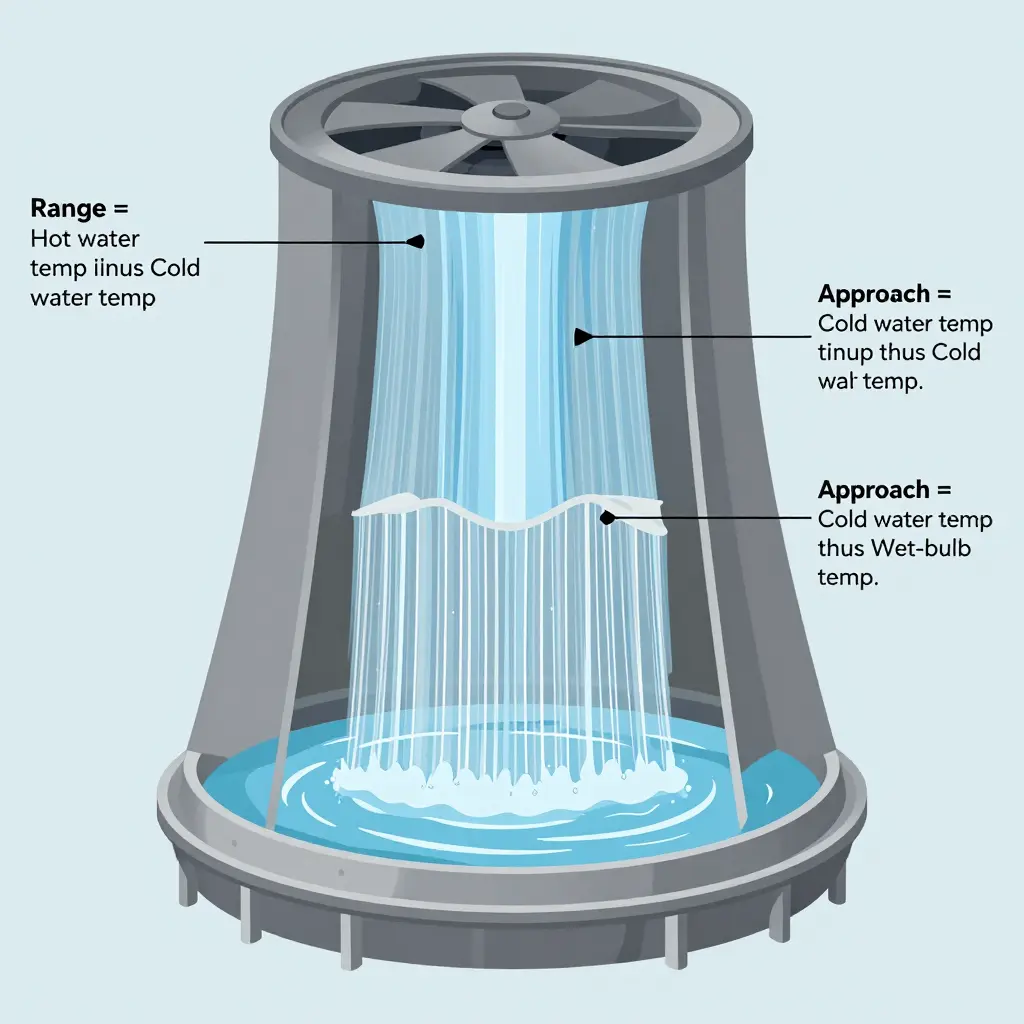
- Range is the temperature drop across the tower: hot condenser water in minus cold water out.
- Approach is the gap between the cold water leaving the tower and the ambient wet-bulb.
Approach tells you how hard the tower is working. A tight approach (say 4F) puts the leaving water very close to the wet-bulb floor, which demands more airflow, more fill surface, and far more fan power. As the wet-bulb rises, the achievable approach inevitably widens.
| Ambient wet-bulb (F) | Realistic approach (F) | Cold water achievable (F) |
|---|---|---|
| 62 | 5 | 67 |
| 70 | 6 | 76 |
| 76 | 8 | 84 |
| 80 | 11 | 91 |
Why a Lower Setpoint Forces the Tower to Work Harder
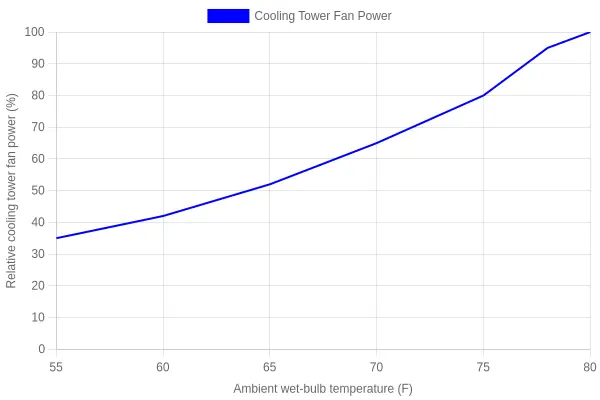
Drop the condenser water setpoint and the tower must produce colder water for the same heat load. That means a larger range and a tighter approach, which a fixed-speed tower cannot deliver without more air, so the fan runs longer and harder. The effect is especially punishing when the wet-bulb creeps close to the setpoint: efficiency per unit of airflow collapses, and a large amount of fan energy chases a small temperature gain. The chart below shows the shape of that penalty.
Variable-Speed Fans and Tower Fan Power Behavior
Tower fan energy follows the fan affinity laws: power scales roughly with the cube of speed. Cut airflow to 80 percent and fan power can fall to about half. Variable-speed drives exploit this by trimming airflow whenever the wet-bulb is low or the load is light. The cube law cuts the other way too, so the last few degrees of temperature demand a disproportionate jump in power. A modest setpoint reset can therefore save chiller kilowatts while shifting a heavier burden onto the tower fans.
The Practical Limit of the Tower
Every tower has a design approach, and there is a point where no amount of airflow buys a colder drop. Once the wet-bulb approaches the setpoint minus the minimum approach, the fan is effectively maxed out, and further setpoint reduction only wastes energy. The real goal is to reset the setpoint so that chiller and tower savings balance, and to stop chasing condenser water colder than the ambient conditions can support.
Implementing a Condenser Water Reset Strategy: A Practical Checklist
Condenser water reset is one of the higher-value, lower-cost optimization moves available to a plant team. The idea is simple: lower the condenser water supply temperature whenever the cooling tower can produce it cheaply, so the chillers run with less compressor lift and use less power. The catch is the crossover point where rising fan and pump energy swallows the savings. The steps below run from the first measurement to long-term tuning, in the order you should tackle them.
-
Map the system and install meters first. You cannot optimize what you do not measure. Inventory every chiller, condenser pump, and cooling tower, then add power meters plus temperature sensors at the chiller condenser inlet and outlet and at the tower supply and return.
-
Collect high-resolution trend data. Log power (kW), temperatures, flow, and ambient wet-bulb at one-to-five-minute intervals for several weeks, so the analysis captures part-load operation and weather swings instead of a single snapshot.
-
Establish baseline power measurements. Normalize chiller performance in kW/ton and total plant kW against a common touchpoint such as outdoor wet-bulb, to build a before-and-after benchmark you can defend.
-
Compute the optimal setpoint curve. Combine the baseline data with manufacturer chiller curves to find the condenser water temperature that minimizes combined chiller-plus-tower energy at each load and wet-bulb condition.
-
Configure the control sequence. Program the reset logic in the building automation system: modulate the condenser water setpoint between a maximum and a minimum based on wet-bulb, load, or condenser valve position, with clear priorities and deadbands to prevent hunting.
-
Set safe minimum setpoints. Protect the machines with a floor on condenser water temperature that respects manufacturer limits, refrigerant pressure, and oil-cooling requirements, even when the tower offers more capacity.
-
Commission and verify the strategy. Run controlled tests across the full operating range, confirm valve and variable-frequency-drive responses, and document measured savings against the baseline so you know the sequence behaves as intended.
-
Monitor continuously and re-tune. Track key performance indicators, alarm on anomalies such as low approach or high lift, and revisit the setpoint curve seasonally as equipment, loads, and conditions drift.
Treat this list as a loop, not a finish line. Once the reset curve is running, the data you gather feeds a sharper curve next season, and the savings accumulate in the background.
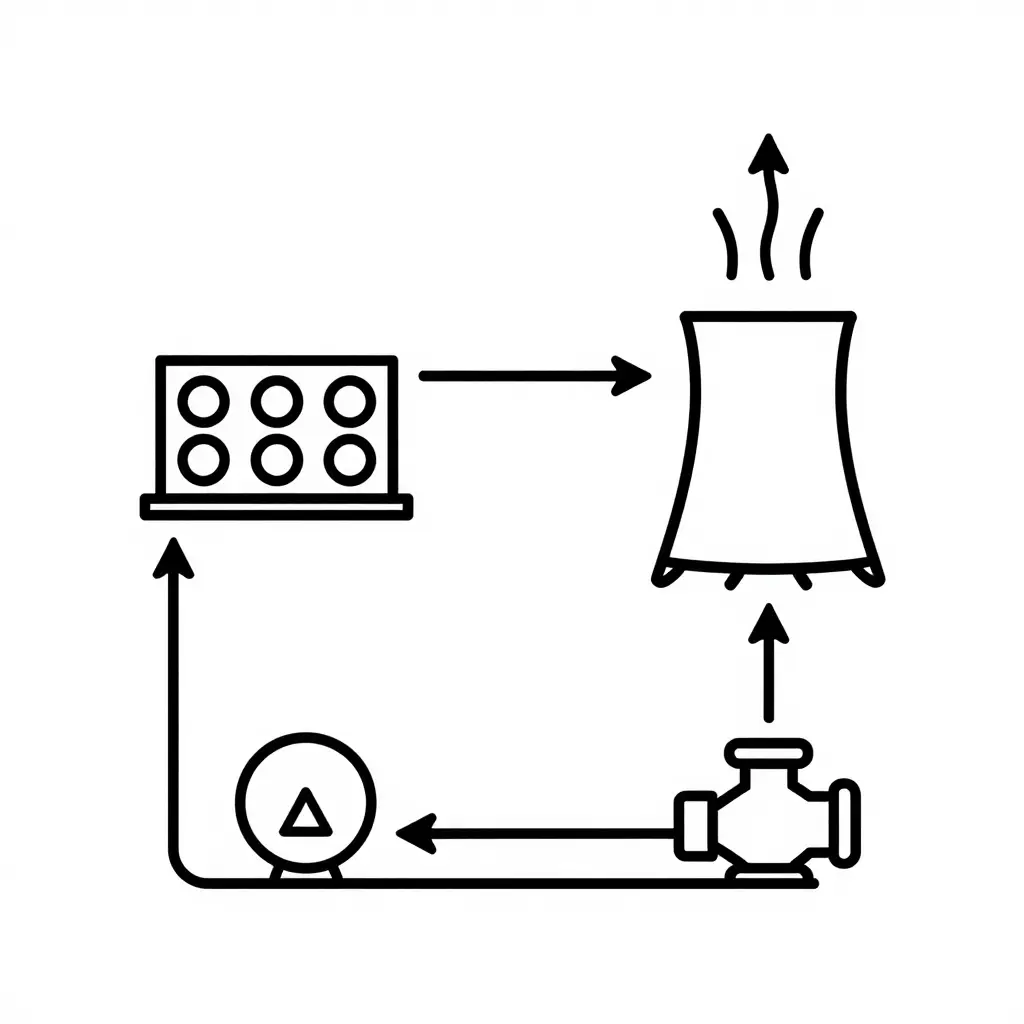
The diagram below traces a condenser water reset loop in its simplest form. Two inputs, the current cooling load and the outdoor wet-bulb temperature, feed forward into a single comparison step, where they are checked against the optimal setpoint curve. That comparison produces one output: an adjusted condenser water setpoint that the control sequence then applies. Following the arrows left to right, you can see how the loop stays closed and self-correcting instead of relying on a fixed, static temperature.
Control Strategies and Setpoint Optimization Logic
Once you accept that condenser water temperature is a dial worth turning, the next question is how to turn it. There is no single right answer, because every control strategy is an attempt to approximate the true total-power minimum, the point where the chiller’s savings from colder water are exactly offset by the cooling tower fan’s added penalty. The approaches differ in how much they cost to build, how many sensors they demand, and how gracefully they fail.
The target: the true total-power minimum
The chart below shows the trade-off in its simplest form. As you drop the condenser water setpoint, chiller power falls while tower fan power climbs. The total is a shallow U-shape, and the bottom of that U is the operating point you want.
Wet-bulb reset
Wet-bulb reset ties the condenser water setpoint to the outdoor wet-bulb temperature plus a fixed approach, say wet-bulb + 8 F. Because the tower’s theoretical limit is always the ambient wet-bulb, this strategy naturally runs the plant colder on cool, dry days and warmer on muggy ones. It needs only one reliable sensor, which makes it cheap, transparent, and easy to commission. The catch: it ignores chiller load and tower fan energy, so it can leave savings on the table during light-load hours when a warmer setpoint would actually win.
Load-based reset
Load-based reset schedules the setpoint against chiller percent load, typically holding a lower temperature during high load and drifting warmer as the building unloads. It stays simple and sensor-light, and it respects the fact that chiller efficiency penalties grow at part load. Its weakness is that it does not directly sense tower power, so the schedule is an educated guess that must be tuned by hand and retuned as equipment ages.
Optimal setpoint curves
Optimal curves are the middle path. Instead of one variable, the setpoint is a function of both load and wet-bulb, derived from vendor performance data or measured power. They track the true minimum far more closely than either simple reset and still run open-loop once built, with no live power measurement required. The trade-off is engineering effort: the curve has to be generated, validated, and revisited.
Power-minimizing (demand-based) control
This is the closed-loop approach. The controller nudges the condenser water setpoint up and down, measures the resulting change in total plant power, and seeks the minimum, an adaptive, self-optimizing hunt. It converges on the genuine optimum regardless of fouling, weather, or degraded equipment, which makes it the most accurate setpoint optimization method available. The price is complexity: it needs power metering on chillers and fans, a stable control loop, and patience, because it has to test the plant in order to learn from it.
Comparing the four approaches
| Strategy | Approximation of true minimum | Sensor needs | Complexity | Reliability |
|---|---|---|---|---|
| Wet-bulb reset | Good on weather, ignores load | 1 wet-bulb | Low | Very high |
| Load-based reset | Moderate, schedule-dependent | Load signal | Low | High |
| Optimal curve | Close, data-derived | Load + wet-bulb | Medium | High |
| Power-minimizing | Closest, self-tuning | Load + wet-bulb + power | High | Moderate |
Practical safeguards
No strategy should be allowed to run unsupervised into unsafe territory. Always enforce:
- Minimum setpoint limit (often 65-70 F) to keep chiller approach, oil pressure, and compressor lift within safe bounds.
- Maximum setpoint limit (typically 85-90 F) to protect against high head pressure and surge.
- Minimum tower approach so the setpoint is never commanded below what the tower can physically deliver.
- Flow and freeze protection to guard against low evaporator or condenser flow and cold-weather icing.
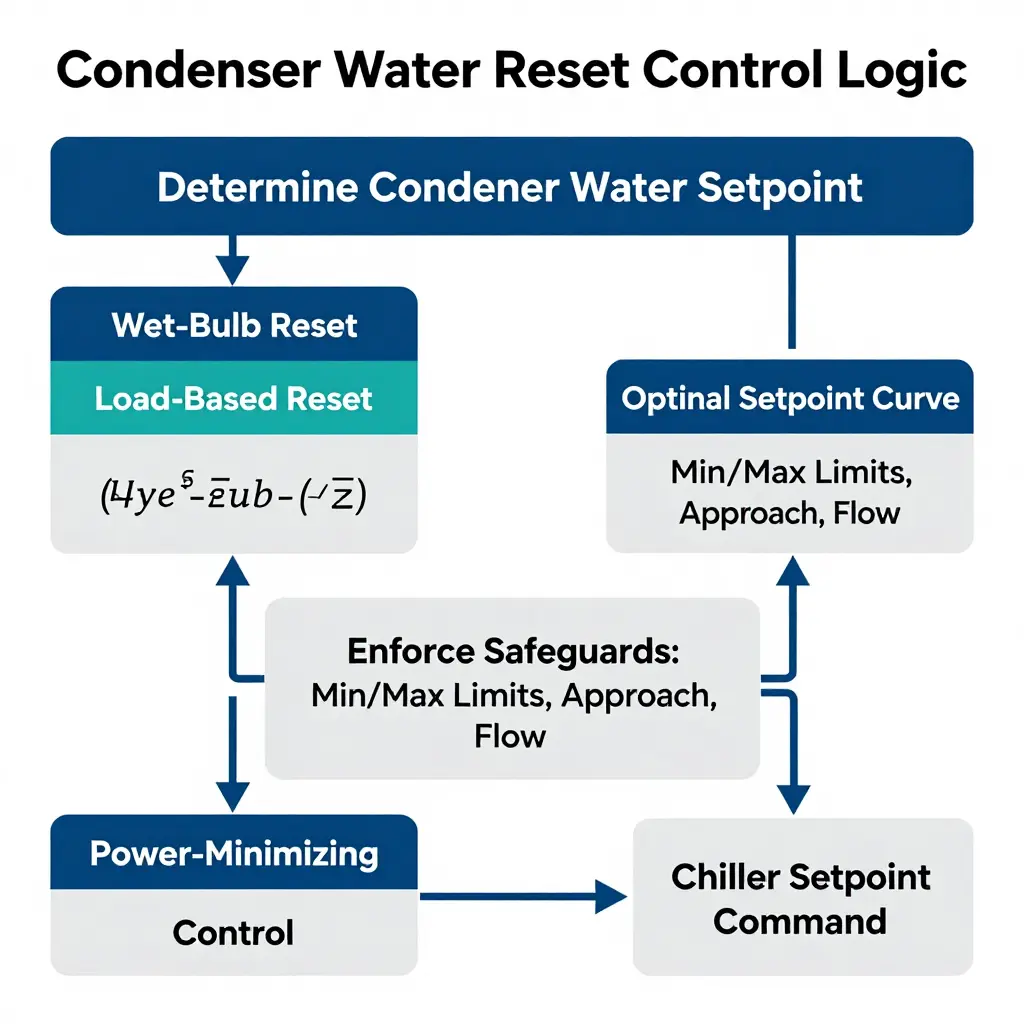
Start simple with wet-bulb reset, add load and curve logic as metering allows, and graduate to power-minimizing control once the data infrastructure is in place. The logic matters less than the discipline of guarding the envelope around it.
Where Does the Chiller Plant’s Energy Actually Go?
Before you touch a single setpoint, it helps to see the whole picture. The doughnut chart below shows how total chilled-plant energy splits across the major components. The chiller compressor takes the overwhelming majority of the load, while the cooling tower fans and condenser pumps each take a smaller but still measurable slice. That imbalance is why condenser water reset is such a strong lever: a modest nudge in tower fan or pump energy can buy a much larger swing in compressor energy.
Chilled-Plant Energy Breakdown
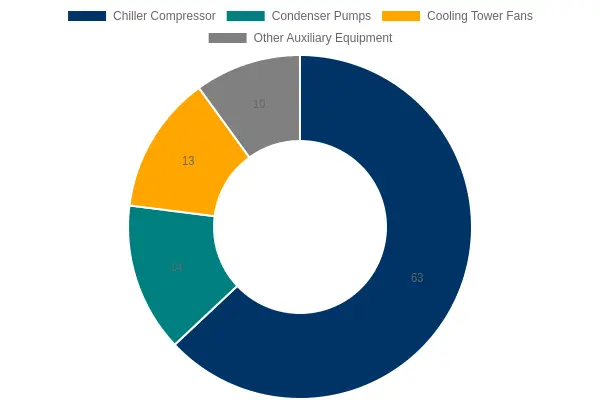
| Component | Share of Total Plant Energy |
|---|---|
| Chiller Compressor | 63% |
| Condenser Pumps | 14% |
| Cooling Tower Fans | 13% |
| Other Auxiliary Equipment | 10% |
The relationship matters more than the exact numbers. Because the compressor dominates, cooling tower fan energy is a meaningful but clearly secondary component. Spending a little more fan energy to lower the condenser water temperature often gives back far more on the chiller side, which is the logic behind resetting condenser water.
Frequently Asked Questions About Condenser Water Reset
What is condenser water reset?
Condenser water reset is the practice of adjusting the temperature of the water flowing through a chiller’s condenser, usually by lowering the setpoint when outdoor conditions allow. In a water-cooled plant, the cooling tower rejects heat while the chiller lifts it to a higher temperature, so resetting the loop temperature lets the tower shoulder more of the work when the weather cooperates. Rather than running a fixed setpoint year-round, operators schedule or dynamically tune the temperature to follow load and wet-bulb conditions. The aim is to strike the best balance between chiller efficiency and cooling tower fan energy.
Does lowering condenser water temperature always save energy?
No. Lowering condenser water temperature almost always improves chiller efficiency, but it also forces the cooling tower to work harder, and those two effects can cancel each other out. Every degree of reduction trims chiller compressor power, yet it may add tower fan and pump energy, especially when the tower is already near its capacity. The net outcome depends on the equipment, the load, and the ambient conditions, which makes reset an optimization exercise rather than a one-way switch.
How is the optimal setpoint determined?
The optimal setpoint is the temperature at which the combined power of the chillers, cooling tower fans, and condenser pumps is minimized for a given load and wet-bulb reading. Engineers find it using chiller and tower performance curves, trend data, and on-site testing, sometimes supported by automated optimization software. In practice, operators run a short experiment: nudge the setpoint and watch total plant kilowatts to see whether it rises or falls. Over time, that produces a relationship that can be scheduled or controlled automatically.
What minimum condenser water temperature is safe?
Safety limits vary by manufacturer, but most water-cooled centrifugal and screw machines specify a minimum entering condenser water temperature, often in the range of 60 degrees F to 65 degrees F, to protect the compressor. Going below that can trigger surge, oil management issues, or lubrication problems, particularly on older units. Variable-speed and magnetic-bearing chillers frequently tolerate lower minimums, sometimes down to 55 degrees F or less. Always confirm the approved range in the specific equipment’s operating manual before resetting lower.
How does wet-bulb temperature affect the trade-off?
Wet-bulb temperature sets the practical floor for how cold a cooling tower can make the water, because towers reject heat primarily through evaporation. When wet-bulb is low, the tower can produce cooler water cheaply, so resetting the condenser setpoint lower tends to win. When wet-bulb is high, driving the water colder demands far more fan energy, so the chiller-side savings may no longer justify the tower-side penalty. Monitoring wet-bulb alongside load tells you which side of the trade-off you are on at any given time.
Can reset be automated with existing controls?
Yes, in most cases. Building automation systems and chiller plant managers can implement reset through schedules, outdoor-air or wet-bulb reset curves, or demand-based optimization without replacing major equipment. What is often needed is reliable instrumentation, such as accurate temperature sensors, a wet-bulb or humidity input, and kilowatt metering on the primary plant components. Once those signals are available, the control logic itself is usually straightforward to configure.
What maintenance issues affect condenser water reset performance?
Fouling is the quiet enemy of any reset strategy. Scale and biofouling inside condenser tubes and cooling tower fill raise approach temperatures, so the plant delivers warmer water than the setpoint predicts and savings quietly disappear. Regular water treatment, tube cleaning, and tower inspection keep measured performance aligned with the optimization model. Without that discipline, even a well-tuned reset sequence will underperform.
Conclusion: The Sweet Spot of Condenser Water Reset
Every efficient chilled water plant lives inside a tug-of-war. Lower the condenser water temperature and the chiller rewards you with a lighter lift, a lower compression ratio, and a smaller appetite for compressor power. But cooling that water demands more work from the tower: more fan speed, longer run times, and sometimes more makeup water. Push the water colder still, and the tower’s energy penalty starts to cancel out the chiller’s savings. Push it warmer, and the chiller pays instead.
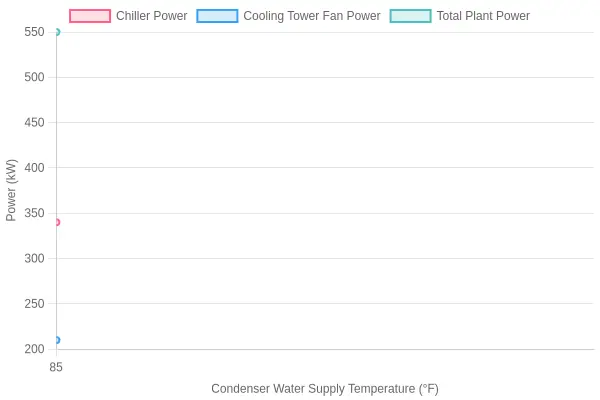
The chart below captures that balance. Chiller power slides steadily downward as condenser water temperature drops, tower power climbs upward, and the sum of the two, total plant power, forms a bowl. The bottom of that bowl is the goal.
The Key Takeaways
Total plant power is minimized at a specific setpoint, not at the lowest condenser water temperature the tower can physically deliver. Running the loop as cold as possible is not the same as running it as efficiently as possible. The optimal setpoint sits somewhere in the middle, and it shifts with outdoor wet-bulb temperature, load profile, tower staging, and equipment condition.
Consolidated Best Practices
The most reliable results come from a consistent set of practices:
- Find the setpoint by measurement, not habit. Trend chiller and tower power together across a range of temperatures and identify the true minimum for your plant.
- Respect the physical floor. Set a realistic lower limit based on tower approach and design wet-bulb so the plant never chases an unattainable condition.
- Implement a modest reset schedule, typically a few degrees, tied to load or wet-bulb, rather than large aggressive swings.
- Protect the machines. Verify that minimum lift and surge limits are not violated at colder condenser temperatures.
- Commission and calibrate sensors so every decision is based on trustworthy temperature and power data.
- Stage and sequence tower fans to match the load instead of running all cells at partial speed.
- Review the strategy seasonally, because the optimum in July is rarely the optimum in January.
Looking Ahead
Plant efficiency is not a one-time tune-up but a continuous loop of monitoring, learning, and adjustment. Modern building automation systems, power meters, and analytics platforms make it possible to track condenser water reset performance in real time and let the setpoint drift gently toward the true optimum as conditions change. Teams that treat optimization as an ongoing discipline, rather than a project with an end date, will keep capturing savings year after year.